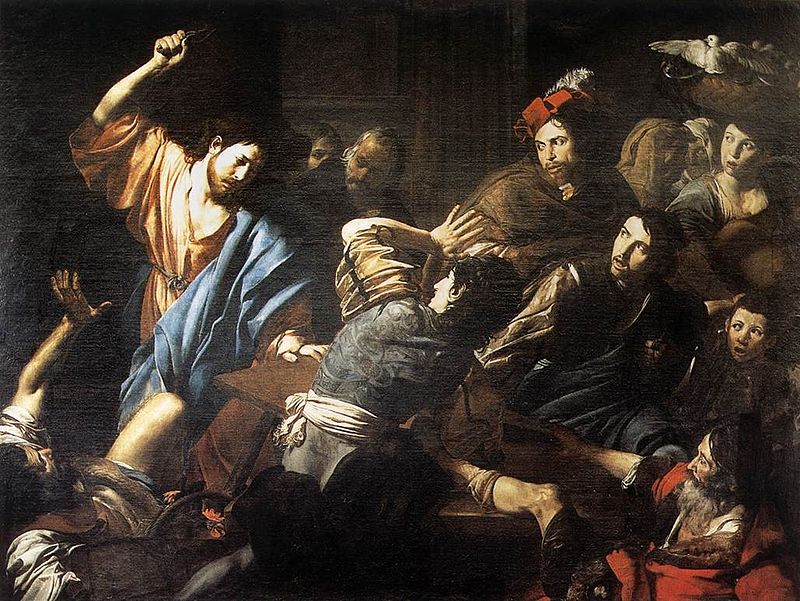
Christ Driving the Money Changers out of the Temple Valentin de Boulogne
Then Jesus entered the temple and drove out all who were selling and buying in the temple, and he overturned the tables of the money changers and the seats of those who sold doves.
He said to them, "It is written, 'My house shall be called a house of prayer' but you are making it a den of robbers."
The blind and the lame came to him in the temple, and he cured them.
But when the chief priests and the scribes saw the amazing things that he did, and heard the children crying out in the temple, "Hosanna to the Son of David," they became angry and said to him, "Do you hear what these are saying?"
Jesus said to them, "Yes; have you never read, 'Out of the mouths of infants and nursing babies you have prepared praise for yourself'?"
He left them, went out of the city to Bethany, and spent the night there. In the morning, when he returned to the city, he was hungry. And seeing a fig tree by the side of the road, he went to it and found nothing at all on it but leaves.
Then he said to it, "May no fruit ever come from you again!"
And the fig tree withered at once.
When the disciples saw it, they were amazed, saying, "How did the fig tree wither at once?" Jesus answered them, "Truly I tell you, if you have faith and do not doubt, not only will you do what has been done to the fig tree, but even if you say to this mountain, 'Be lifted up and thrown into the sea,' it will be done. Whatever you ask for in prayer with faith, you will receive." – Matthew 21:12-22 (NRSV)
Let's get one thing out of the way, the elephant in the room.
Why did Jesus curse the fig tree?
Was it just a response to yesterday's bad day where he had been dealing with mental and spiritual atrophy, corruption of intended purpose, and petty criticism?
Was it because he was hungry and there were no figs?
Was he angry? Was he setting up a lesson? Was he cursing an entire nation for being fruitless? Was he demonstrating the power of faith?
I am not sure. You can explore that on your own time and dime.
Matthew pairs the story with Jesus' lesson on the power of faith to move mountains, thus using one metaphor to explain another.
He also places it at the conclusion of an opening story about perverted purpose in a religious context.
Perversion and corruption are pretty fruitless endeavors.
Temple worship had become a big business and collaboration with illegitimate powers such as Herod had overwhelmed the meaning of the worship that the people were coming to the temple to bring. In fact, sincere worshipers were being oppressed.
Jesus quotes from Isaiah:
"I will bring them to my holy mountain, where they will celebrate in my house of worship. Their sacrifices and offerings will always be welcome on my altar. Then my house will be known as a house of worship for all nations." – Isaiah 56:7 (Contemporary English Version)
The temple powers of the day, under the influence of the priests who were under the influence of the political powers were excluding the nations from the worship of YHWH.
They were capitalizing on the vulnerability of people, cheating them, in the place dedicated for the gentiles to worship.
So, he made a dramatic demonstration of indignation. It was no time for subtlety.
His actions were out of godly anger, but they were measured to be just outrageous and offensive enough to make a point that no one could miss.
Everything about the day was dramatic, even the fig tree.
What happened next, as Matthew emphasizes, was also dramatic, but gentle.
The people, the masses, the broken, wounded, sick, and sad saw an ally in him. They interpreted what he had done as more than just prophetic; it was compassionate.
This invader was on their side. He was a friend of the poor and the outcast.
So they came to him and he healed them. This stirred up the chief priests and their stirring was exacerbated by the cries of children.
Children are notoriously good judges of character.
They called him by a messianic name, "Son of David."
The religious men were furious.
Jesus, again, quoted scripture:
"Out of the mouth of babes and sucklings hast thou ordained strength because of thine enemies, that thou mightest still the enemy and the avenger." – Psalm 8:2
And that was the end of that day's activities. He left the city for his home away from home in Bethany.
Then he returned to Jerusalem and we get the account of the tree.
Hopefully, those of you who have been reading the bible for years have figured out that we do Jesus a grave injustice when we try to make him a literal dogmatist.
No teacher has ever been as great a master of stirring up thought and upsetting the mental apple cart of locked in thinking as Jesus. If there was a frozen presupposition to challenge, he would do it. If there was a way to make people scratch their heads, he was all in.
Why?
He wanted his disciples to go for the deep roots of God's will and truth and he did it with drama, stories, questions, metaphors, and humor.
What is the purpose of a fruit-bearing tree?
Fruit!
Where had he been seeking fruit the day before?
From the temple.
What was preventing the fruit?
The corrupt established powers that were running the show?
What would happen in about 40 years?
That establishment would crumble with the temple itself?
Would that be the end of the matter? The end of all fig trees? The end of Israel? The end of God's purposes?
Not the way I read the rest of the story.
This is the third day of Advent on December 3, 2019.
When the Son of David shows up, you can expect some things to get knocked around and some people to get offended.
What would happen he showed up in some of our temples of power and religion today?
It is easy to find out. Just take him to those places.
Fuller has a good article on the "elephant."
This video is not bad either:

 Pastor Tom's Community
Leave a comment