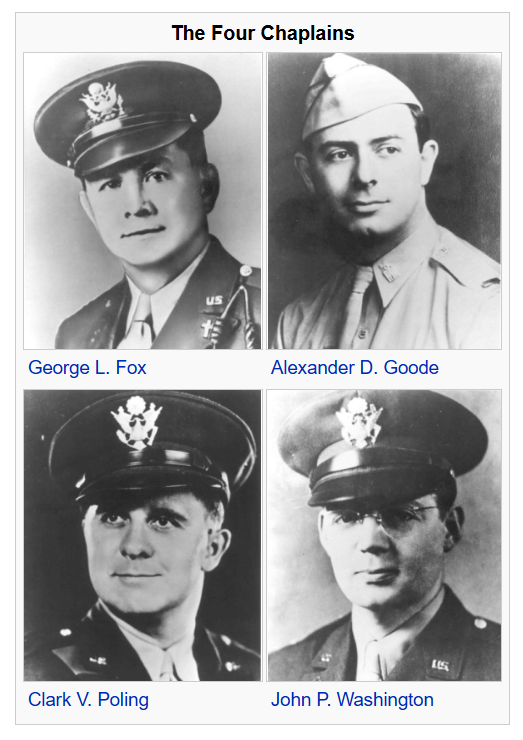
On February 3, 1943, Methodist minister the Reverend George L. Fox, Reform Rabbi Alexander D. Goode, PhD, Catholic priest Father John P. Washington, and Reformed Church in America minister the Reverend Clark V. Poling were all together on the SS Dorchester.
It was a civilian liner that had been converted to military use during word War II and was transporting 900 military personnel to Greenland.
Thee vessel was torpedoed by the German submarine off Newfoundland. The chaplains who had met in chaplain’s school and were all new to their work, helped the other soldiers board lifeboats and gave up their own life jackets when the supply ran out.
They joined arms, said prayers, and sang hymns as they went down with the ship.
I was deeply moved by a the tribute to them in the Wax Museum in Washington D.C. as a boy and it is an image that has stayed with me through the years and has, in many ways, informed my understanding of ministry.
“As I swam away from the ship, I looked back. The flares had lighted everything. The bow came up high and she slid under. The last thing I saw, the Four Chaplains were up there praying for the safety of the men. They had done everything they could. I did not see them again. They themselves did not have a chance without their life jackets.” — Grady Clark, survivor
“According to some reports, survivors could hear different languages mixed in the prayers of the chaplains, including Jewish prayers in Hebrew and Catholic prayers in Latin. Only 230 of the 904 men aboard the ship were rescued. ” – Wikipedia

 Pastor Tom's Community
Leave a comment