“And they mourned, and wept, and fasted…”
— 2 Samuel 1:12
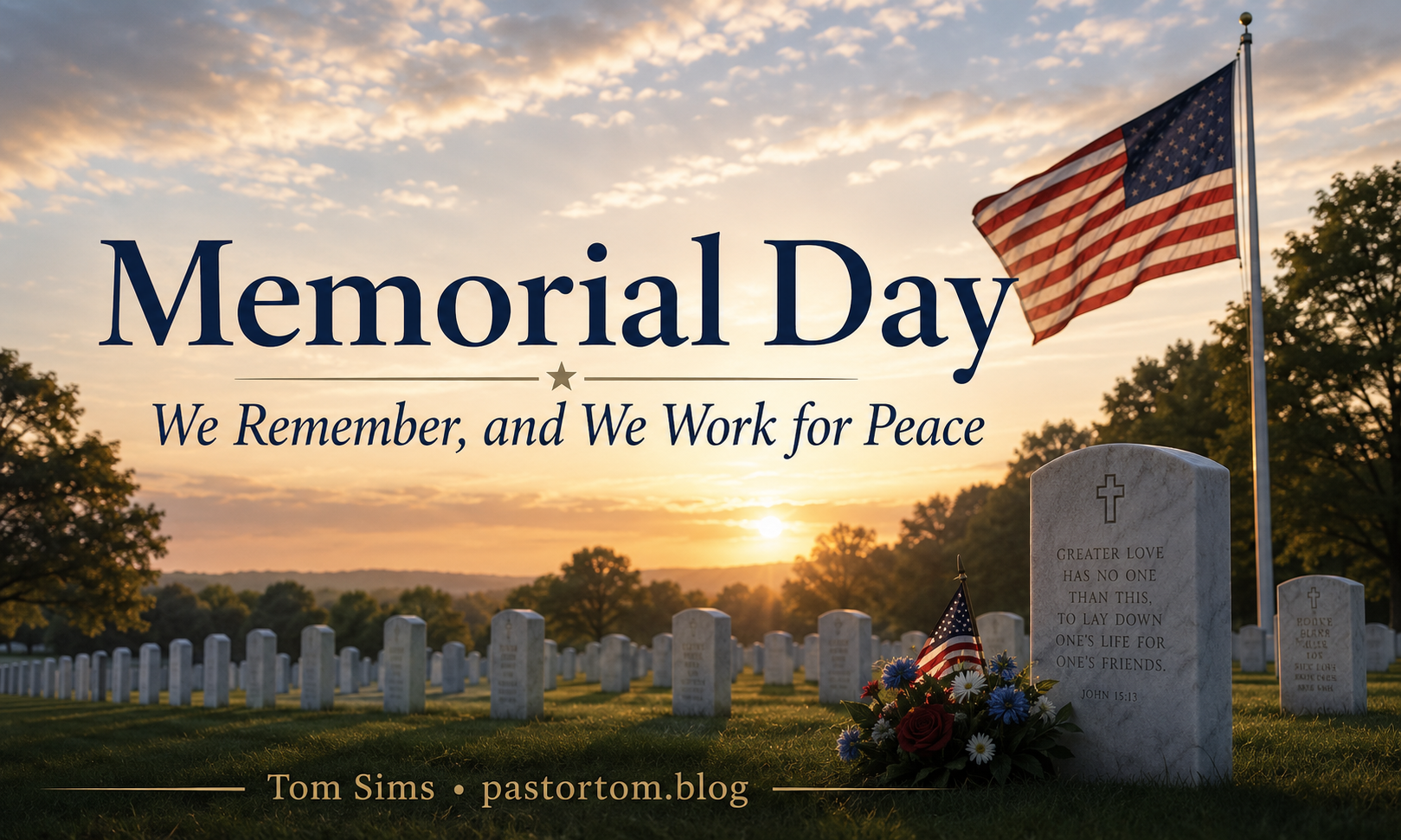
A Memorial Day reflection on remembrance, mourning, sacrifice, and the Christian call to honor the fallen while working, praying, and persuading for peace.
On this Memorial Day morning, I find myself looking back over posts I have shared, blogs I have published, articles I have written, sermons I have preached, and devotionals I have prepared on this solemn day of remembrance.
And I am reminded again how difficult it is to put this day in proper perspective.
I am always looking for the spiritual word — the word from God that speaks into the middle of a meaningful public and civic holiday. I am always asking how Scripture helps us honor those who lost their lives in war while also following Jesus, the Peacemaker.
That is not always simple.
As a follower of Jesus, and especially as one who has often opposed war when war was presented as an option, I must still say this clearly:
We honor those who put themselves in harm’s way.
We honor those who dedicated themselves to duty.
We honor those who fought for causes they may or may not have fully understood, because in so many wars, ordinary people do not know all that is happening in the rooms where decisions are made.
But they served.
They gave.
They sacrificed.
And many did not come home.
They left a hole in the world.
They left a hole in families.
They left a hole in homes, communities, circles of friendship, and in the heart of the nation.
We truly lost them.
We did not lose their memories. We did not lose the snapshots of who they were. Even after the sounds of their voices fade from memory, we remember how they made people feel. We remember the love they gave, the promise they carried, the lives they were still building.
And so, we remember.
Scripture takes remembering seriously.
Esther 9:28 says:
“And that these days should be remembered and kept throughout every generation, every family, every province, and every city; and that these days of Purim should not fail … nor the memorial of them perish…”
The context is different, but the principle remains. People need memorials. Nations need days of remembrance. Families need sacred pauses where grief is permitted, gratitude is expressed, and the names of the dead are not allowed to vanish into silence.
We remember because forgetting would be a second loss.
We remember because every grave marker is more than a name, more than a rank, more than a date. It marks a person who loved and was loved.
There were songs still to be sung. Books still to be written. Children still to be raised. Homes still to be built. Gardens still to be planted. Friendships still to be deepened. Laughter still to be shared.
There was much left to do.
And so, it is left to us to remember.
David understood this. When Saul and Jonathan fell in battle, Scripture says:
“And they mourned, and wept, and fasted until even, for Saul, and for Jonathan his son, and for the people of the Lord…”
— 2 Samuel 1:12
There is no war without death.
There is no death without grief.
There must be no grief without mourning.
Mourning is holy work. It is how we honor love. It is how we make room for truth. It is how we confess that human life is precious and that no life given in service should be treated as disposable.
So today, we mourn.
We mourn those who died in uniform.
We mourn the families who never again heard a familiar footstep at the door.
We mourn the empty chair.
We mourn the unfinished life.
We mourn with gratitude, but gratitude does not cancel sorrow. It gives sorrow a place to stand.
And then we ask: What shall we do with this memory?
Beyond singing heart-stirring songs, waving flags, attending ceremonies, and offering words of support, what can we do?
I believe we owe something to everyone who puts on a uniform.
We owe it to them to minimize the risk that they will have to use the weapons they have been given.
We owe it to them to make the world as safe as we can.
We owe it to them to press for wisdom, restraint, diplomacy, justice, and peace among those who make decisions that send men and women into harm’s way.
We do this through our prayers.
We do this through our politics.
We do this through persuasion.
We do this through our influence.
We do this through our insistence that human life matters.
We do this through our commitment to seek peace without pretending evil does not exist.
There will be threats. There will be violence. There will be times when nations face real danger and armed conflict may come. We live in a world wounded by sin, pride, greed, fear, aggression, and domination.
But those realities do not relieve us of the call to be peacemakers.
Jesus said:
“Blessed are the peacemakers: for they shall be called the children of God.”
— Matthew 5:9
Peacemaking is not passivity. It is not denial. It is not weakness.
Peacemaking is active. It requires courage. It requires discernment. It requires moral clarity. It requires the willingness to confront evil without becoming addicted to violence.
And it requires memory.
If we remember rightly, we do not glorify war.
We honor courage.
We honor sacrifice.
We honor duty.
We honor love.
We honor those who gave everything.
But we do not make war sacred.
Only God is sacred.
Jesus once said:
“Render therefore unto Caesar the things which be Caesar’s, and unto God the things which be God’s.”
— Luke 20:25
On Memorial Day, we honor those who rendered much to their country. Some rendered all their earthly tomorrows. They gave their lives in service to home, neighbor, nation, and ideals larger than themselves.
But we also remember that Caesar is not God.
Nation is not God.
Flag is not God.
Military power is not God.
The God and Father of our Lord Jesus Christ alone is worthy of worship. And because He is God, every human life matters to Him. The soldier matters. The civilian matters. The grieving widow matters. The orphan matters. The enemy matters. The wounded veteran matters. The policymaker matters. The peacemaker matters.
All stand before God.
All are known to God.
None are forgotten by God.
So we pray.
We pray for those who grieve today.
We pray for parents who buried children.
We pray for spouses who carried folded flags home in trembling hands.
We pray for sons and daughters who grew up with stories instead of memories.
We pray for veterans who returned carrying grief others cannot see.
We pray for military families still living with uncertainty.
We pray for leaders, that they may be guided by wisdom, humility, restraint, truth, and justice.
We pray for our enemies, because Jesus did not make that optional.
We pray for peace.
We pray for righteousness.
We pray for the day when swords are beaten into plowshares and nations learn war no more.
And while we pray, we remember.
We remember them not as abstractions, not as symbols only, not as political talking points, but as people.
People who loved.
People who were loved.
People whose lives mattered.
People whose memory must not perish.
May God comfort those who mourn.
May God give wisdom to those who lead.
May God restrain the violent.
May God strengthen the weary.
May God heal the wounded.
May God teach us to remember well.
And may God make us instruments of peace.
Amen.
Further Reflection
This devotional reflection also has two companion pieces for readers who want to go deeper.
On Medium, I offer a shorter reflective article on the forgotten Black history of Memorial Day and what it means to remember honestly:
The Memorial Day Story We Forgot to Remember
https://medium.com/@tomsims/the-memorial-day-story-we-forgot-to-remember-6734f1a76f16?sk=00fd4f4844b8a6eb8b5d4e687faf3270
At Wednesday in America, I take a deeper civic look at Memorial Day, moral memory, forgotten history, and the Black Americans who helped shape one of its earliest observances:
Memorial Day, Moral Memory, and the Black Americans Who Helped Begin It
https://tomsims.substack.com/p/memorial-day-moral-memory-and-the
Together, these pieces invite us to remember more fully, more truthfully, and more gratefully.
 Pastor Tom's Community
Leave a comment