At the Foot of the Mountain
Exodus 19:16–25
🔗 Read the full passage:
https://www.biblegateway.com/passage/?search=Exodus%2019%3A16-25&version=NRSVUE
The Scene: When God Draws Near
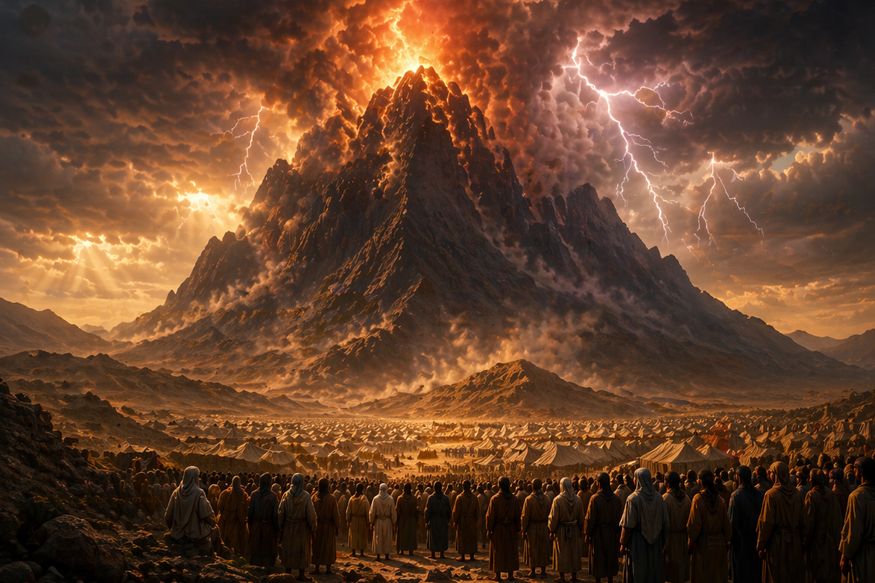
On the morning of the third day, the mountain comes alive:
- Thunder and lightning
- A thick cloud
- Fire and smoke
- A trumpet blast growing louder and louder
This is not background noise.
This is summons.
God is not only revealing Himself—He is calling His people to assemble.
Creation itself becomes the medium of announcement.
The same God who governs nature now uses it to declare His presence, His authority, and His glory.
And the people respond as human beings always do when confronted with the holy:
They tremble.
The Movement: From Camp to Encounter
“Moses brought the people out of the camp to meet God.”
This is where we linger.
Moses does what he has been called to do from the beginning:
- He leads
- He mediates
- He brings people toward God
But on this day—this incomparable day—he does it for all the people at once.
This is not a private vision.
This is not an isolated spiritual moment.
This is corporate encounter.
He brings them:
- Out of the camp
- Out of the familiar
- Out of their comfort
And toward something they cannot control, define, or fully approach.
They are brought to the mountain.
The Posture: Standing at the Boundary
“They took their stand at the foot of the mountain.”
This is the first act of a receptive people.
They stand.
They do not rush forward.
They do not retreat backward.
They do not attempt to manage the moment.
They stand where they are told to stand.
This is sacred tension:
- God is near
- God is dangerous
- God is inviting
- God is holy
Boundaries are set—not to exclude—but to teach reverence.
Even the priests must consecrate themselves.
Access to God is not casual.
It is graced, mediated, and holy.
The Leader and the People
Moses stands in a unique role:
- A priest among a priestly people
- A prophet among a prophetic nation
- A leader appointed by God
He hears from God.
He speaks to the people.
He moves between the two.
What he does here is what faithful leaders always do:
He brings people to the edge of encounter—
but not beyond what God permits.
The Invitation: Come, But Do Not Break Through
God’s instruction is clear:
- Come near
- But do not break through
- Consecrate yourselves
- Respect the boundary
There is both invitation and warning.
This is not contradiction—it is theology.
God is:
- Transcendent (beyond us)
- Immanent (near to us)
To approach Him rightly requires both:
- Desire (we come)
- Reverence (we do not presume)
The Reflection
There is much more in this passage—and in the chapters surrounding it.
But for today, the focus is simple and deliberate.
My calling in this moment has been to bring you to the foot of the mountain.
Not to explain everything.
Not to resolve every tension.
Not to rush past the moment.
But to bring you here.
Your Task
Stand.
Wait.
Receive.
Read the passage again.
Meditate on it.
Let the sounds, the fire, the trembling, and the boundary speak.
You have been brought out of the camp.
Now remain at the foot of the mountain—
until God speaks.
🧭 Discussion & Group Reflection (Fellowship of Joy)
1. What “camp” might God be calling you out of right now?
Comfort? Routine? Assumptions?
2. How do you respond when you sense the presence of God—
with curiosity, fear, reverence, resistance?
3. Why do you think God establishes boundaries in moments like this?
What do boundaries protect or teach?
4. What does it mean in practical terms to “stand and wait” before God today?
5. Where do you see the role of a “Moses” in your life—someone who has helped bring you closer to God?
Closing Thought
Not every moment is meant to be explained.
Some moments are meant to be entered.
Sinai is one of those moments.
Stand there a while.
 Pastor Tom's Community
Leave a comment