Bible Chat – Leviticus 16:20–34
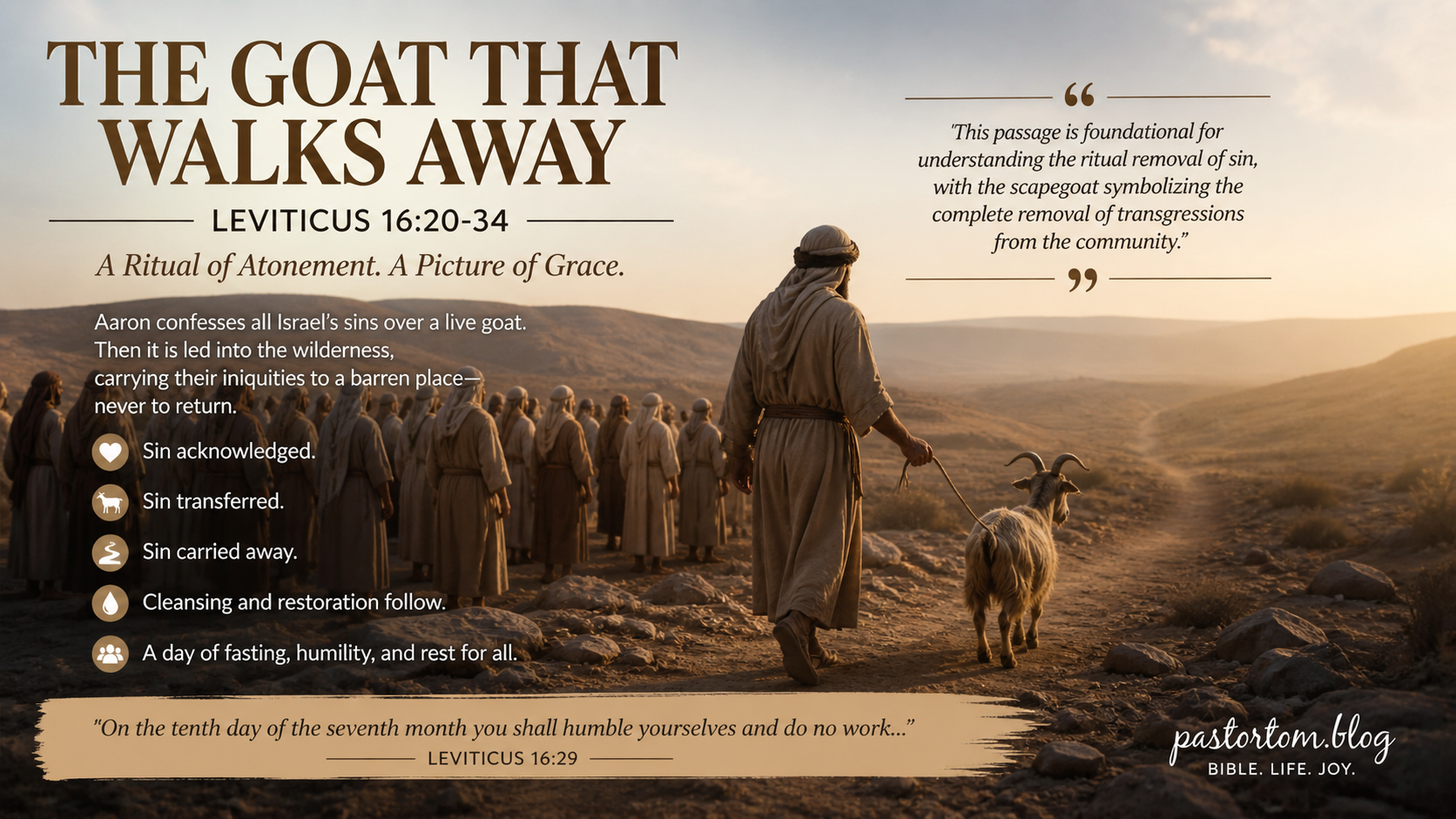
There is a moment in this ritual that invites us to stop and watch.
Aaron has spoken the words.
Hands pressed firmly on the head of the goat.
Every category of failure named—iniquities, transgressions, sins.
And now… the goat begins to walk.
Away from the camp.
Away from the people.
Away from the presence of God’s dwelling among them.
What Were They Feeling?
Imagine standing there.
You have brought nothing in your hands.
You have said nothing aloud.
But everything—everything—has just been confessed over that animal.
And now it is leaving.
At first, you can still see it clearly.
Then it becomes smaller.
Then it is only a moving shape on the horizon.
Then… it is gone.
What happens in the human heart in that moment?
- Relief – It’s not on me anymore.
- Hope – Maybe we can begin again.
- Awe – God has made a way for this.
- Silence – because some things cannot be explained, only received
But perhaps also:
- Sobriety – Sin is real, and it costs something.
- Dependence – We cannot cleanse ourselves.
The people are not cheering.
They are not celebrating loudly.
They are watching… and letting go.
The Theology in Motion
This is not abstract doctrine.
It is theology you can see walking away.
The scapegoat embodies a staggering claim:
Sin can be transferred.
Sin can be carried.
Sin can be removed.
Not ignored.
Not excused.
Removed.
Sent to a “barren region”—a place of no return.
And Then… Life Resumes
The ritual does not end with the goat.
There is washing.
There is re-clothing.
There are offerings.
There is restoration.
Even the one who led the goat away must be cleansed before reentering the camp.
Why?
Because contact with sin—even symbolically—leaves residue.
Grace removes guilt.
But holiness still matters.
A Community Reset
This was not optional.
- A set day
- A set practice
- For everyone—native and stranger alike
- With fasting, rest, and humility
Once a year, the entire community stopped and faced reality:
We need atonement.
We need cleansing.
We need God to do what we cannot do.
From Scapegoat to Fulfillment
This moment becomes a foundation.
Judaism carries it forward in the Day of Atonement (Yom Kippur).
Christian theology looks back and sees in it a pattern fulfilled in Christ.
Not one theory—but many streams of understanding—flow from here:
- Substitution
- Sacrifice
- Cleansing
- Reconciliation
Each one echoes this wilderness scene:
Something carries away what we cannot carry ourselves.
A Question for Us
We no longer stand in that camp.
But we still struggle with the same question:
Do we actually let our sins go… or do we keep chasing the goat?
Do we:
- Reclaim what God has removed?
- Rehearse what God has forgiven?
- Carry what has already been carried away?
Spiritual Imagination
Picture it again.
The goat is almost out of sight.
What would it mean—for you—to let it go completely?
Not halfway.
Not temporarily.
But fully.
Closing Reflection
God did not design a system where people pretend they are clean.
He gave them a way to become clean.
And for one long, quiet moment each year,
they could stand together…
and watch their sins disappear into the wilderness.
Deep Dive Bible Studies at Bible Chat Online
Today’s Studies
Children of the Day
1 Thessalonians 5 is one of the most practical chapters in the New Testament. It reminds us who we are—children of light—and calls us to live awake, together, and ready.
In this Bible Chat, we walk through Paul’s rapid-fire instructions for daily living: Stay alert and sober Encourage one another Rejoice, pray, and give thanks Test everything and hold on to what is good
This is not about fear—it’s about identity.
📖 Read the full Bible Chat (Substack): https://tomsims.substack.com/p/children-of-the-day
Stop Fretting and Start Trusting
https://tomsims.substack.com/p/stop-fretting-start-trusting
Psalm 37


 Pastor Tom's Community
Leave a reply to DeGnomeKing Cancel reply