II Thessalonians 2:1–17
In 2 Thessalonians 2:1–17, Paul addresses fear, confusion, deception, and endurance. Some believers had become alarmed by claims that “the day of the Lord” had already arrived. Rumors, teachings, and perhaps even letters falsely attributed to Paul were circulating among the churches, disturbing people and shaking their confidence.
Paul’s response is pastoral before it is prophetic.
His first concern is not speculation about timelines, but stability of heart and mind.
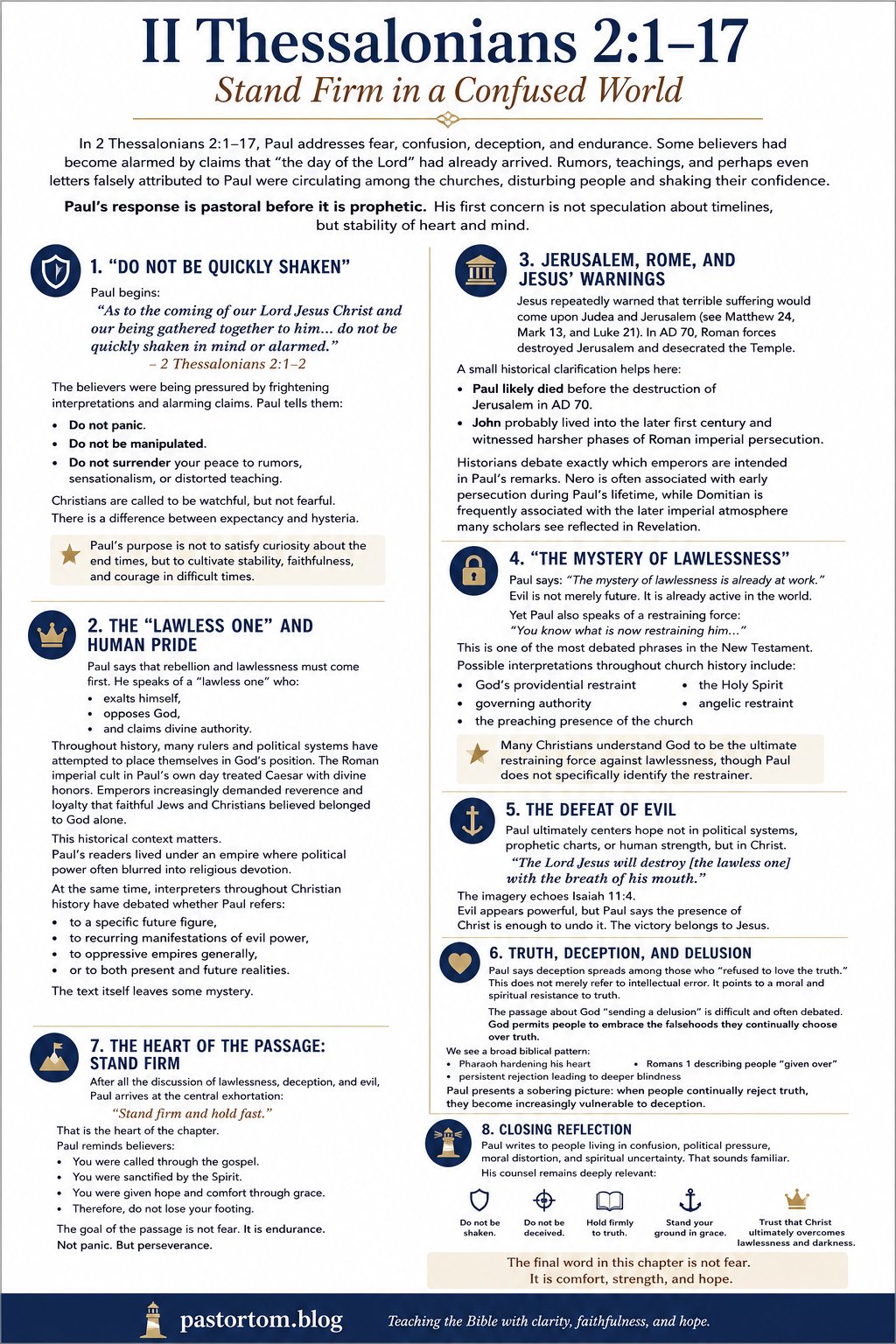
“Do Not Be Quickly Shaken”
Paul begins:
“As to the coming of our Lord Jesus Christ and our being gathered together to him… do not be quickly shaken in mind or alarmed.”
— 2 Thessalonians 2:1–2
The believers were being pressured by frightening interpretations and alarming claims. Paul tells them:
- Do not panic.
- Do not be manipulated.
- Do not surrender your peace to rumors, sensationalism, or distorted teaching.
Christians are called to be watchful, but not fearful.
There is a difference between expectancy and hysteria.
Paul’s purpose is not to satisfy curiosity about the end times, but to cultivate stability, faithfulness, and courage in difficult times.
The “Lawless One” and Human Pride
Paul says that rebellion and lawlessness must come first. He speaks of a “lawless one” who:
- exalts himself,
- opposes God,
- and claims divine authority.
Throughout history, many rulers and political systems have attempted to place themselves in God’s position. The Roman imperial cult in Paul’s own day treated Caesar with divine honors. Emperors increasingly demanded reverence and loyalty that faithful Jews and Christians believed belonged to God alone.
This historical context matters.
Paul’s readers lived under an empire where political power often blurred into religious devotion.
At the same time, interpreters throughout Christian history have debated whether Paul refers:
- to a specific future figure,
- to recurring manifestations of evil power,
- to oppressive empires generally,
- or to both present and future realities.
The text itself leaves some mystery.
Jerusalem, Rome, and Jesus’ Warnings
Jesus repeatedly warned that terrible suffering would come upon Judea and Jerusalem (see Matthew 24, Mark 13, and Luke 21). In AD 70, Roman forces destroyed Jerusalem and desecrated the Temple.
A small historical clarification helps here:
- Paul likely died before the destruction of Jerusalem in AD 70.
- John probably lived into the later first century and witnessed harsher phases of Roman imperial persecution.
Historians debate exactly which emperors are intended in Paul’s remarks. Nero is often associated with early persecution during Paul’s lifetime, while Domitian is frequently associated with the later imperial atmosphere many scholars see reflected in Revelation.
“The Mystery of Lawlessness”
Paul says:
“The mystery of lawlessness is already at work.”
Evil is not merely future. It is already active in the world.
Yet Paul also speaks of a restraining force:
“You know what is now restraining him…”
This is one of the most debated phrases in the New Testament.
Possible interpretations throughout church history include:
- God’s providential restraint,
- governing authority,
- the Holy Spirit,
- angelic restraint,
- the preaching presence of the church.
Many Christians understand God to be the ultimate restraining force against lawlessness, though Paul does not specifically identify the restrainer.
The Defeat of Evil
Paul ultimately centers hope not in political systems, prophetic charts, or human strength, but in Christ.
“The Lord Jesus will destroy [the lawless one] with the breath of his mouth.”
The imagery echoes Isaiah 11:4.
Evil appears powerful, but Paul says the presence of Christ is enough to undo it.
The victory belongs to Jesus.
Truth, Deception, and Delusion
One of the sobering themes in this passage is the danger of rejecting truth.
Paul says deception spreads among those who “refused to love the truth.”
This does not merely refer to intellectual error. It points to a moral and spiritual resistance to truth.
The passage about God “sending a delusion” is difficult and often debated. God permits people to embrace the falsehoods they continually choose over truth.
We see a broad biblical pattern:
- Pharaoh hardening his heart,
- Romans 1 describing people being “given over,”
- persistent rejection leading to deeper blindness.
Paul presents a sobering picture: when people continually reject truth, they become increasingly vulnerable to deception.
The Heart of the Passage: Stand Firm
After all the discussion of lawlessness, deception, and evil, Paul arrives at the central exhortation:
“Stand firm and hold fast.”
That is the heart of the chapter.
Paul reminds believers:
- You were called through the gospel.
- You were sanctified by the Spirit.
- You were given hope and comfort through grace.
- Therefore, do not lose your footing.
The goal of the passage is not fear.
It is endurance.
Not panic.
But perseverance.
Closing Reflection
Paul writes to people living in confusion, political pressure, moral distortion, and spiritual uncertainty.
That sounds familiar.
His counsel remains deeply relevant:
- Do not be shaken.
- Do not be deceived.
- Hold firmly to truth.
- Stand your ground in grace.
- Trust that Christ ultimately overcomes lawlessness and darkness.
The final word in this chapter is not fear.
It is comfort, strength, and hope.
If this reflection on II Thessalonians 2:1–17 resonated with you, I invite you to continue the conversation in the deeper-dive Bible Chat edition on Substack.
There, I explore:
- the “mystery of lawlessness,”
- truth and deception in modern culture,
- the Roman imperial background behind Paul’s words,
- discernment versus fear and conspiracy thinking,
- spiritual endurance in confusing times,
- and practical ways believers can “stand firm and hold fast.”
The Substack edition also includes:
- the full long-form Bible Chat podcast,
- a companion infographic/chart,
- extended reflections,
- post-paywall study materials,
- and Fellowship of Joy small-group discussion resources.
Continue the Deep Dive Here
Bible Chat Substack — Stand Firm in a Confused World
In an age of confusion, distortion, and anxiety, Paul’s message remains profoundly relevant:
“Stand firm and hold fast.”
 Pastor Tom's Community
Leave a comment