A Theological Reflection on Genesis 3
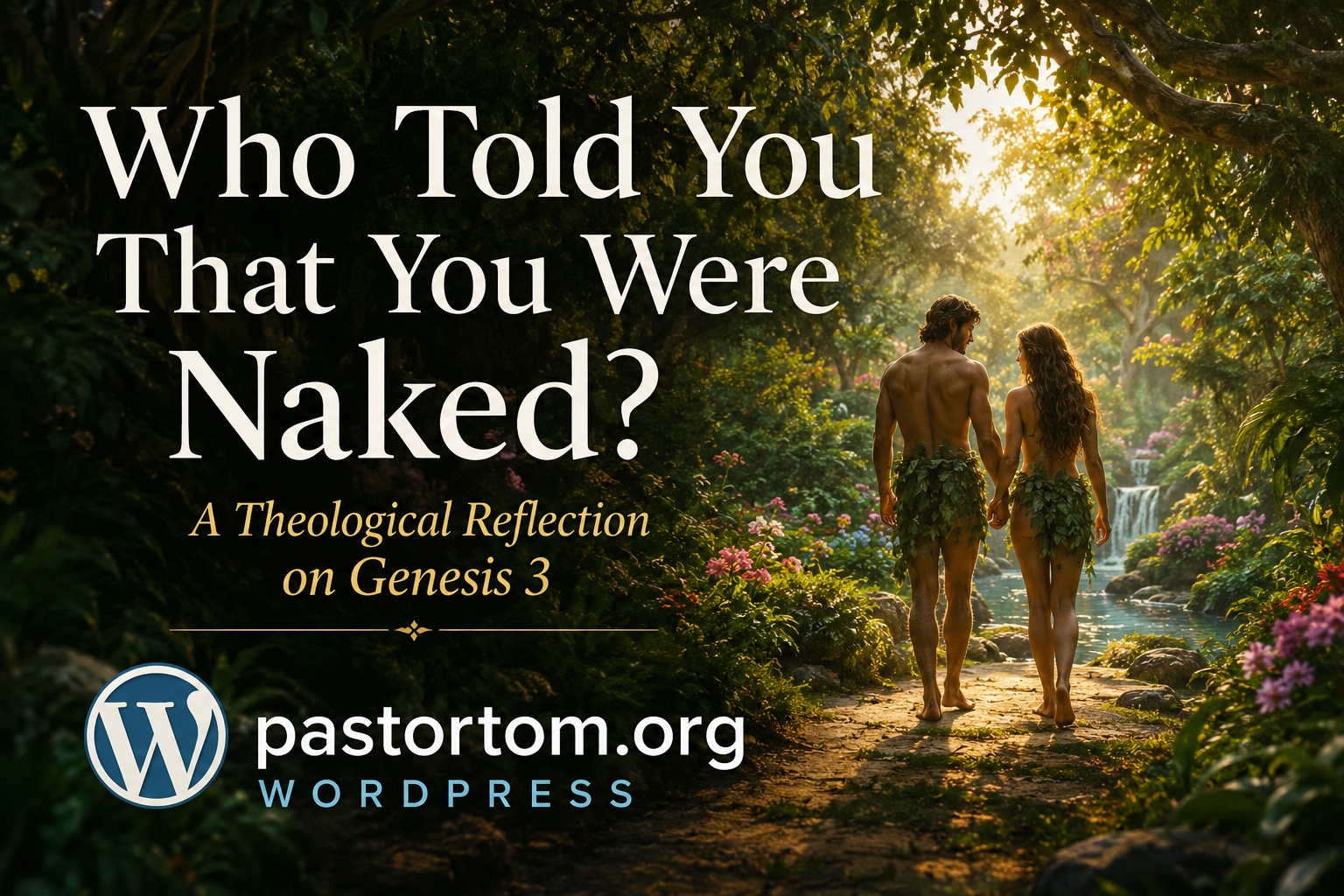
There are questions in scripture that echo through the entire human story.
This is one of them:
“Who told you that you were naked?” — Genesis 3:11
Not merely:
What have you done?
But:
Who told you?
That question cuts deeper than behavior. It probes awareness, identity, shame, vulnerability, alienation, and consciousness itself.
This meditation explores something profound and often overlooked in Genesis 3: the “fall” is not merely an act of disobedience. It is an awakening into self-conscious vulnerability.
Adam and Eve eat the fruit, and suddenly the world is no longer experienced as pure gift and trust. They become aware—not merely of morality—but of exposure.
They know they are naked.
Before this moment, nakedness was not a problem:
“And the man and his wife were both naked, and were not ashamed.” — Genesis 2:25
Afterward, shame enters immediately—not because their bodies changed, but because their perception changed.
The serpent promises:
“You will be like God, knowing good and evil.”
The narrative itself confirms part of this:
“See, the man has become like one of us, knowing good and evil…” — Genesis 3:22
The serpent lies and tells the truth simultaneously, which is often how temptation works.
Humanity gains discernment, moral consciousness, evaluative awareness. But it gains these things without the fullness, wisdom, holiness, or stability of God.
The result is not divine maturity.
It is existential vulnerability.
Nakedness as Vulnerability
I lock the door to the bathroom because I do not wish to be caught off guard.
Why do humans seek privacy in vulnerability?
Why does nakedness matter?
Not merely because of sexuality—but because nakedness symbolizes defenselessness.
To be naked is to be:
- exposed,
- unguarded,
- unable to hide,
- unable to control perception,
- vulnerable to judgment,
- vulnerable to harm.
Genesis suggests humanity did not originally experience vulnerability as threat.
Creation was trustworthy.
God was trustworthy.
One another were trustworthy.
The garden was a place where vulnerability was safe.
Sin, though Genesis uses neither the terms “sin” nor “fall” in the narrative, fractures trust.
Suddenly Adam and Eve hide:
- from one another,
- from themselves,
- from creation,
- from God.
And perhaps that is one of the deepest consequences of sin:
not simply guilt, but the inability to remain open.
“Who Told You?”
God’s question is psychologically and spiritually penetrating.
Who introduced shame?
Who introduced fear?
Who taught suspicion?
Who convinced humanity that exposure required hiding?
The question implies that shame itself is not native to creation.
Fear enters through alienation.
The human pair now interpret reality through danger-awareness.
The world has changed—or perhaps more accurately, they have changed.
The Knowledge of Good and Evil
We need to avoid simplistic readings.
“Knowledge of good and evil” is more than acquiring ethical categories. In Hebrew thought, it often implies autonomous moral authority—the capacity to determine, evaluate, and judge independently.
Humanity grasps for prerogatives belonging to God.
The issue is not intelligence.
It is autonomy.
The temptation is:
“You may define reality for yourselves.”
And humanity still repeats that impulse endlessly.
Mortality and Mercy
Here is an important observation:
God does not destroy the Tree of Life.
He guards it.
This matters profoundly.
Humanity in its fractured condition cannot safely possess immortality.
An eternally fallen humanity would be horrifying.
Mortality becomes both judgment and mercy.
Death limits evil.
Death humbles pride.
Death reminds humanity:
you are not God.
And yet even there, grace appears.
The First Covering
One of the most beautiful moments in Genesis 3 is this:
“And the Lord God made garments of skins for the man and for his wife, and clothed them.” — Genesis 3:21
Before sacrifice systems.
Before covenants.
Before Sinai.
Before priesthood.
God covers humanity.
The God from whom they hide becomes the God who clothes them.
This is the first act of redemptive accommodation.
They cannot return to innocence.
But they are not abandoned.
The covering motif then echoes through scripture:
- Noah covered,
- Israel covered,
- sins covered,
- mercy seat covering,
- Christ covering shame,
- believers clothed in righteousness.
The biblical story moves from nakedness to covering to glory.
Naked and Unashamed No More
“Naked and unashamed no more.”
That may summarize the human condition.
We hide.
We perform.
We construct identities.
We armor ourselves psychologically, spiritually, socially, politically, and emotionally.
Yet scripture consistently moves toward restoration of trustful openness before God.
Not naïveté.
Not ignorance.
But redeemed vulnerability.
Christ as the Reversal
Paul indeed becomes the major interpreter of Adam in the New Testament.
“For as all die in Adam, so all will be made alive in Christ.” — 1 Corinthians 15:22
The Christ enters human vulnerability fully:
- born exposed,
- tempted,
- rejected,
- stripped,
- crucified publicly.
The cross itself is an image of ultimate nakedness and vulnerability.
And there, shame is overcome not by denial, but by love.
The gospel does not merely forgive disobedience.
It restores relationship.
It invites humanity out of hiding.
Final Reflection
Perhaps the question still echoes toward every human heart:
Who told you you were unworthy?
Who told you you were only your shame?
Who told you you must hide from God?
Who told you vulnerability meant abandonment?
Genesis 3 is not only about humanity falling.
It is about God still walking in the garden afterward.
Still seeking.
Still speaking.
Still covering.
Still inviting humanity to return.

 Pastor Tom's Community
Leave a comment