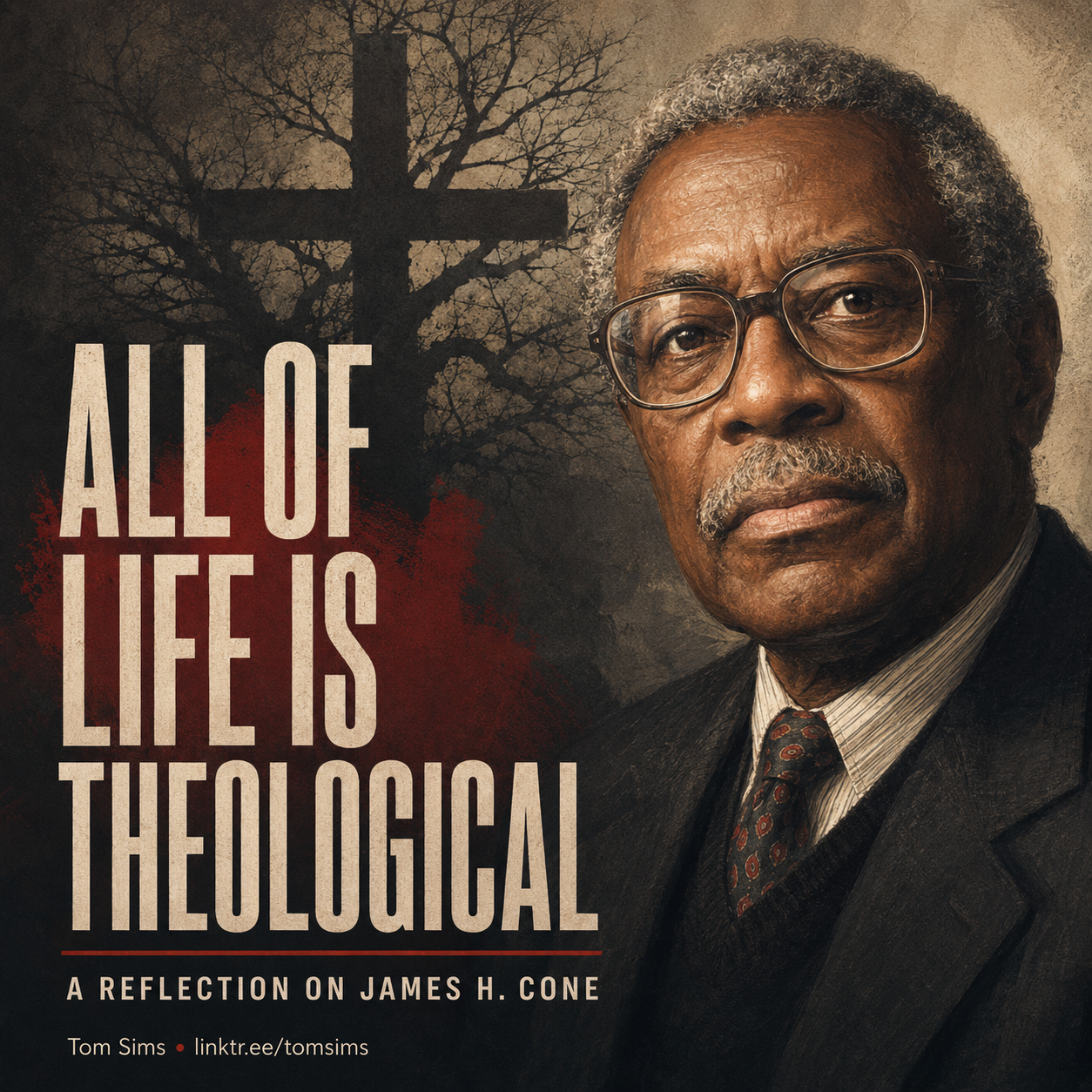
James H. Cone, widely regarded as the father of Black liberation theology, taught us that theology does not begin and end in the classroom. It is not merely an academic exercise or a collection of abstract ideas about God.
Theology arises from life.
It takes root in human existence—in suffering, struggle, hope, and the daily effort to live with dignity. It begins wherever people ask whether God sees them, hears them, values them, and intends something better for them.
Cone insisted that God does not remain at a safe distance from human history. In Christ, God enters human life. God meets people in the realities of oppression, pain, poverty, rejection, and resistance. Theology, therefore, must be worked out not only from above, through doctrines and institutions, but also from below—among those who have been pushed down, pushed aside, or denied their full humanity.
This is where the cross meets the lynching tree.
Cone placed those two terrible instruments of death beside one another because each exposes what oppressive power can do to a human body. The cross cannot be understood merely as a religious symbol detached from history. It was an instrument of public humiliation, state violence, and death. In the American experience, the lynching tree served many of the same purposes.
To speak reverently about the cross while remaining silent about the lynching tree is to separate theology from life. It is to proclaim redemption without confronting the human realities from which people need to be delivered.
Cone’s theology points toward what might be called the bias of God—not an arbitrary favoritism, but God’s determined movement toward those who are suffering and oppressed. A God who loves everyone cannot be neutral when some people are crushing others. Divine love must confront whatever degrades, exploits, excludes, or destroys human beings.
That has implications for redemption and salvation. It also has implications for the transformation of systems.
Systems matter because systems can preserve injustice across generations. They may need to be confronted, dismantled, repaired, or rebuilt. But Cone will not allow us to speak only of systems in the abstract. Systems wound actual people. Oppression appears in faces, bodies, families, neighborhoods, and stories.
God meets us there—in the face-to-face encounter.
God is present with the person struggling to get through another day. God is present with the community fighting to preserve its dignity. God is present among those who have been told that their suffering is unimportant, their history irrelevant, or their liberation inconvenient.
Cone died in 2018, but he left us an enduring body of work and a serious challenge: Where do we expect theology to happen?
If all of life is theological, then no part of life is exempt from the question of God. Our economics, politics, relationships, institutions, prejudices, privileges, suffering, and resistance all become places of theological reflection.
God is in the low places with us. God meets us in our pain and struggle. God speaks among those who long for liberation.
And it is there—in those places—that theology takes root and begins to bloom.
 Pastor Tom's Community
Leave a comment