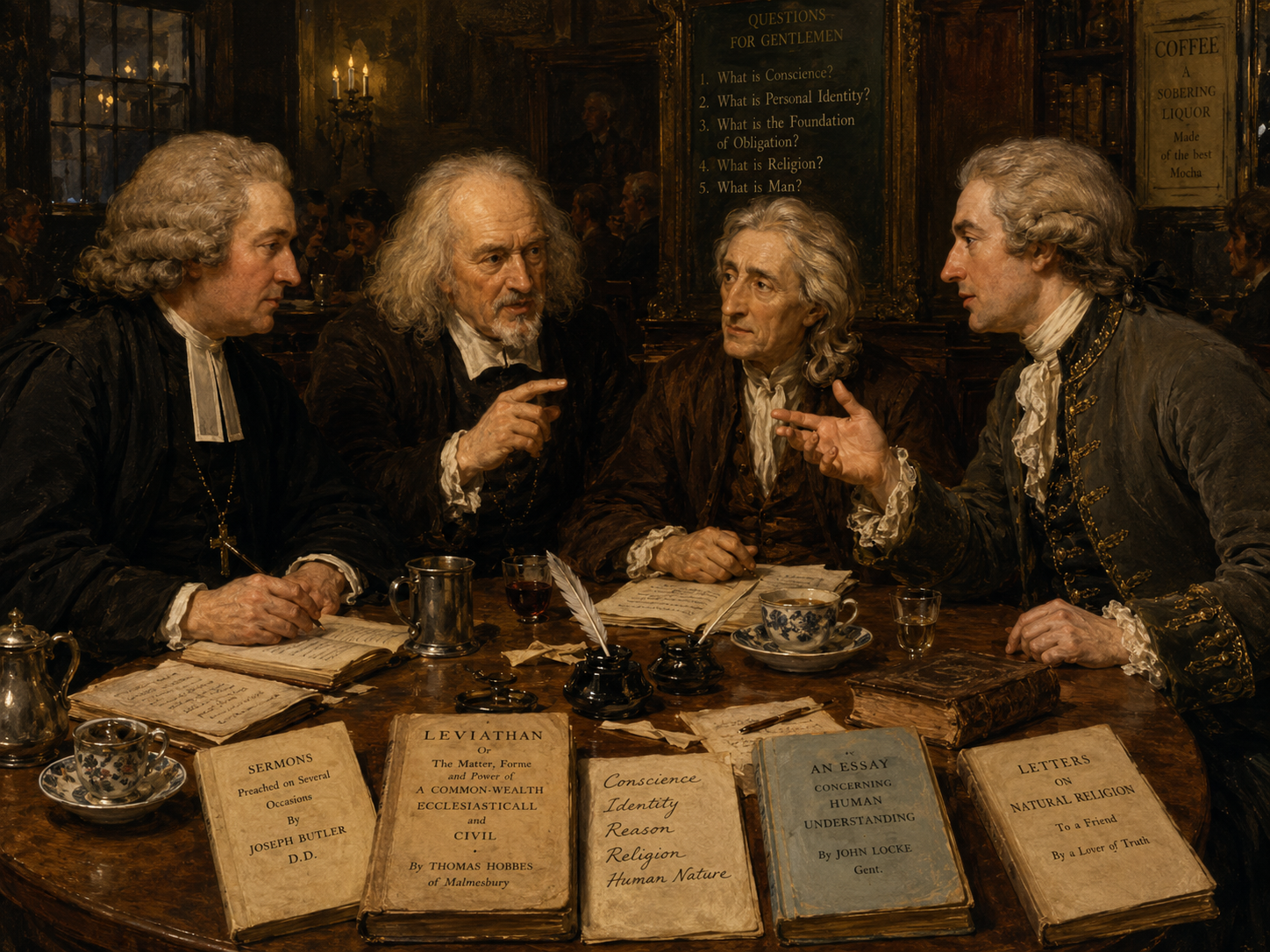
Joseph Butler (1692–1752) was an Anglican bishop, theologian, apologist, and philosopher whose influence reached far beyond his own lifetime. Though remembered as Bishop of Durham and author of The Analogy of Religion and Fifteen Sermons, Butler helped frame questions that later thinkers would develop, sharpen, and debate.
He wrote against the deists of his age, who often pictured God as a distant designer who set the world in motion and then left it alone. Butler’s reply was subtle: nature itself is filled with mystery, incompleteness, probability, and unresolved questions. Therefore, the mysteries of revealed religion should not automatically be dismissed as unreasonable. His famous insight that “probability is the guide of life” shaped his apologetic method.
Butler also anticipated later debates in moral psychology. Against views like Hobbes’s, which reduced human action to self-interest, pleasure, and pain, Butler argued that human beings possess conscience, benevolence, and a moral constitution. We are not merely reward-seeking machines. Conscience, for Butler, has authority within the soul. It may not always have power, but it rightly judges and directs the rest of human nature.
He also challenged John Locke’s account of personal identity. Locke connected identity with memory, but Butler argued that memory presupposes personal identity rather than creating it. In other words, I remember because I am already the same person; memory does not make me the same person.
In these ways, Butler stood ahead of many later conversations: Hume on probability and causation, Reid on common sense, Smith on moral sentiments, Newman on conscience and probability, and later ethical thinkers on the structure of moral obligation. His work was not a complete modern system, but it raised enduring questions about reason, faith, conscience, identity, probability, and the limits of human understanding.
His central contribution may be this: Butler insisted that life is lived under conditions of partial knowledge, yet still requires moral action. We do not know everything, but we know enough to be responsible.
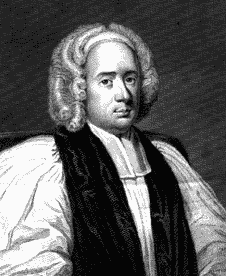
1911 Encyclopædia Britannica/Butler, Joseph
BUTLER, JOSEPH (1692–1752), English divine and philosopher, bishop of Durham, was born at Wantage, in Berkshire, on the 18th of May 1692. His father, a linen-draper of that town, was a Presbyterian, and it was his wish that young Butler should be educated for the ministry in that church. The boy was placed under the care of the Rev. Philip Barton, master of the grammar school at Wantage, and remained there for some years. He was then sent to Samuel Jones’s dissenting academy at Gloucester, and afterwards at Tewkesbury, where his most intimate friend was Thomas Seeker, who became archbishop of Canterbury.
While at this academy Butler became dissatisfied with the principles of Presbyterianism, and after much deliberation resolved to join the Church of England. About the same time he began to study with care Samuel Clarke’s celebrated Demonstration of the Being and Attributes of God, which had been published as the Boyle Lectures a few years previously. With great modesty and secrecy Butler, then in his twenty-second year, wrote to the author propounding certain difficulties with regard to the proofs of the unity and omnipresence of the Divine Being. Clarke answered his unknown opponent with a gravity and care that showed his high opinion of the metaphysical acuteness displayed in the objections, and published the correspondence in later editions of the Demonstration. Butler acknowledged that Clarke’s reply satisfied him on one of the points, and he subsequently gave his adhesion to the other. In one of his letters we already find the germ of his famous dictum that “probability is the guide of life.”
In March 1715 he entered at Oriel College, Oxford, but for some time found it uncongenial and thought of migrating to Cambridge. But he made a close friend in one of the resident fellows, Edward Talbot, son of William Talbot, then bishop of Oxford, and afterwards of Salisbury and Durham. In 1718 he took his degree, was ordained deacon and priest, and on the recommendation of Talbot and Clarke was nominated preacher at the chapel of the Rolls, where he continued till 1726. It was here that he preached his famous Fifteen Sermons (1726), including the well-known discourses on human nature. In 1721 he had been given a prebend at Salisbury by Bishop Talbot, who on his translation to Durham gave Butler the living of Houghton-le-Skerne in that county, and in 1725 presented him to the wealthy rectory of Stanhope. In 1726 he resigned his preachership at the Rolls.
For ten years Butler remained in perfect seclusion at Stanhope. He was only remembered in the neighbourhood as a man much loved and respected, who used to ride a black pony very fast, and whose known benevolence was much practised upon by beggars. Archbishop Blackburne, when asked by Queen Caroline whether he was still alive, answered, “He is not dead, madam, but buried.” In 1733 he was made chaplain to Lord Chancellor Talbot, elder brother of his dead friend Edward, and in 1736 prebendary of Rochester. In the same year he was appointed clerk of the closet to the queen, and had to take part in the metaphysical conversation parties which she loved to gather round her. He met Berkeley frequently, but in his writings does not refer to him. In 1736 also appeared his great work, The Analogy of Religion.
In 1737 Queen Caroline died; on her deathbed she recommended Butler to the favour of her husband. George seemed to think his obligation sufficiently discharged by appointing Butler in 1738 to the bishopric of Bristol, the poorest see in the kingdom. The severe but dignified letter to Walpole, in which Butler accepted the preferment, showed that the slight was felt and resented. Two years later, however, the bishop was presented to the rich deanery of St Paul’s, and in 1746 was made clerk of the closet to the king. In 1747 the primacy was offered to Butler, who, it is said, declined it, on the ground that “it was too late for him to try to support a falling church.” The story has not the best authority, and though the desponding tone of some of Butler’s writings may give it colour, it is not in harmony with the rest of his life, for in 1750 he accepted the see of Durham, vacant by the death of Edward Chandler. His charge to the clergy of the diocese, the only charge of his known to us, is a weighty and valuable address on the importance of external forms in religion. This, together with the fact that over the altar of his private chapel at Bristol he had a cross of white marble, gave rise to an absurd rumour that the bishop had too great a leaning towards Romanism. At Durham he was very charitable, and expended large sums in building and decorating his church and residence. His private expenses were exceedingly small. Shortly after his translation his constitution began to break up, and he died on the 16th of June 1752, at Bath, whither he had removed for his health. He was buried in the cathedral of Bristol, and over his grave a monument was erected in 1834, with an epitaph by Southey. According to his express orders, all his MSS. were burned after his death. Bishop Butler was never married. His personal appearance has been sketched in a few lines by Hutchinson:—“He was of a most reverend aspect; his face thin and pale; but there was a divine placidness which inspired veneration, and expressed the most benevolent mind. His white hair hung gracefully on his shoulders, and his whole figure was patriarchal.”
Butler was an earnest and deep-thinking Christian, melancholy by temperament, and grieved by what seemed to him the hopelessly irreligious condition of his age. In his view not only the religious life of the nation, but (what he regarded as synonymous) the church itself, was in an almost hopeless state of decay, as we see from his first and only charge to the diocese of Durham and from many passages in the Analogy. And though there was a complete remedy just coming into notice, in the Evangelical revival, it was not of a kind that commended itself to Butler, whose type of mind was opposed to everything that savoured of enthusiasm. He even asked John Wesley, in 1739, to desist from preaching in his diocese of Bristol, and in a memorable interview with the great preacher remarked that any claim to the extraordinary gifts of the Holy Spirit was “a horrid thing, a very horrid thing, sir.” Yet Butler was keenly interested in those very miners of Kingswood among whom Wesley preached, and left £500 towards building a church for them. It is a great mistake to suppose that because he took no great part in politics he had no interest in the practical questions of his time, or that he was so immersed in metaphysics as to live in the clouds. His intellect was profound and comprehensive, thoroughly qualified to grapple with the deepest problems of metaphysics, but by natural preference occupying itself mainly with the practical and moral. Man’s conduct in life, not his theory of the universe, was what interested him. The Analogy was written to counteract the practical mischief which he considered wrought by deists and other freethinkers, and the Sermons lay a good deal of stress on everyday Christian duties. His style has frequently been blamed for its obscurity and difficulty, but this is due to two causes: his habit of compressing his arguments into narrow compass, and of always writing with the opposite side of the case in view, so that it has been said of the Analogy that it raises more doubts than it solves. One is also often tempted away from the main course of the argument by the care and precision with which Butler formulates small points of detail.
His great work, The Analogy of Religion, Natural and Revealed, to the Course and Constitution of Nature, cannot be adequately appreciated unless taken in connexion with the circumstances of the period at which it appeared. It was intended as a defence against the great tide of deistical speculation (see Deism), which in the apprehension of many good men seemed likely to sweep away the restraints of religion and make way for a general reign of licence. Butler did not enter the lists in the ordinary way. Most of the literature evoked by the controversy on either side was devoted to rebutting the attack of some individual opponent. Thus it was Bentley versus Collins, Sherlock versus Woolston, Law versus Tindal. The Analogy, on the contrary, did not directly refer to the deists at all, and yet it worked more havoc with their position than all the other books put together, and remains practically the one surviving landmark of the whole dispute. Its central motive is to prove that all the objections raised against revealed or supernatural religion apply with equal force to the whole constitution of nature, and that the general analogy between the principles of divine government, as set forth by the biblical revelation, and those observable in the course of nature, leads us to the warrantable conclusion that there is one Author of both. Without altogether eschewing Samuel Clarke’s a priori system, Butler relies mainly on the inductive method, not professing to give an absolute demonstration so much as a probable proof. And everything is brought into closest relation with “that which is the foundation of all our hopes and of all our fears; all our hopes and fears which are of any consideration; I mean a Future Life.”
Butler is a typical instance of the English philosophical mind. He will admit no speculative theory of things. To him the universe is no realization of intelligence, which is to be deciphered by human thought; it is a constitution or system, made up of individual facts, through which we thread our way slowly and inductively. Complete knowledge is impossible; nay, what we call knowledge of any part of the system is inherently imperfect. “We cannot have a thorough knowledge of any part without knowing the whole.” So far as experience goes, “to us probability is the very guide of life.” Reason is certainly to be accepted; it is pur natural light, and the only faculty whereby we can judge of things. But it gives no completed system of knowledge and in matters of fact affords only probable conclusions. In this emphatic declaration, that knowledge of the course of nature is merely probable, Butler is at one with Hume, who was a most diligent student of the bishop’s works. What can come nearer Hume’s celebrated maxim—“Anything may be the cause of anything else,” than Butler’s conclusion, “so that any one thing whatever may, for aught we know to the contrary, be a necessary condition to any other”?
It is this strong grasp of the imperfect character of our knowledge of nature and of the grounds for its limitation that makes Butler so formidable an opponent to his deistical contemporaries. He will permit no anticipations of nature, no a priori construction of experience. “The constitution of nature is as it is,” and no system of abstract principles can be allowed to take its place. He is willing with Hume to take the course of experience as the basis of his reasoning, seeing that it is common ground for himself and his antagonists. In one essential respect, however, he goes beyond Hume. The course of nature is for him an unmeaning expression unless it be referred to some author; and he therefore makes extensive use of the teleological method. This position is assumed throughout the treatise, and as against the deists with justice, for their whole argument rested upon the presupposition of the existence of God, the perfect Ruler of the world.
The premises, then, with which Butler starts are the existence of God, the known course of nature, and the necessary limitation of our knowledge. What does he wish to prove? It is not his intention to prove God’s perfect moral government over the world or the truth of religion. His work is in no sense a philosophy of religion. His purpose is entirely defensive; he wishes to answer objections that have been brought against religion, and to examine certain difficulties that have been alleged as insuperable. And this is to be effected in the first place by showing that from the obscurities and inexplicabilities we meet with in nature we may reasonably expect to find similar difficulties in the scheme of religion. If difficulties be found in the course and constitution of nature, whose author is admitted to be God, surely the existence of similar difficulties in the plan of religion can be no valid objection against its truth and divine origin. That this is at least in great part Butler’s object is plain from the slightest inspection of his work. It has seemed to many to be an unsatisfactory mode of arguing and but a poor defence of religion; and so much the author is willing to allow. But in the general course of his argument a somewhat wider issue appears. He seeks to show not only that the difficulties in the systems of natural and revealed religion have counterparts in nature, but also that the facts of nature, far from being adverse to the principles of religion, are a distinct ground for inferring their probable truth. He endeavours to show that the balance of probability is entirely in favour of the scheme of religion, that this probability is the natural conclusion from an inspection of nature, and that, as religion is a matter of practice, we are bound to adopt the course of action which is even probably the right one. If, we may imagine him saying, the precepts of religion are entirely analogous in their partial obscurity and apparent difficulty to the ordinary course of nature disclosed to us by experience, then it is credible that these precepts are true; not only can no objections be drawn against them from experience, but the balance of probability is in their favour. This mode of reasoning from what is known of nature to the probable truth of what is contained in religion is the celebrated method of analogy.
Although Butler’s work is peculiarly one of those which ought not to be exhibited in outline, for its strength lies in the organic completeness with which the details are wrought into the whole argument, yet a summary of his results will throw more light on the method than any description can.
Keeping clearly in view his premises—the existence of God and the limited nature of knowledge—Butler begins by inquiring into the fundamental pre-requisite of all natural religion—the immortality of the soul. Evidently the stress of the whole question is here. Were man not immortal, religion would be of little value. Now, Butler does not attempt to prove the truth of the doctrine; that proof comes from another quarter. The only questions he asks are—Does experience forbid us to admit immortality as a possibility? Does experience furnish any probable reason for inferring that immortality is a fact? To the first of these a negative, to the second an affirmative answer is returned. All the analogies of our life here lead us to conclude that we shall continue to live after death; and neither from experience nor from the reason of the thing can any argument against the possibility of this be drawn. Immortality, then, is not unreasonable; it is probable. If, he continues, we are to live after death, it is of importance for us to consider on what our future state may depend; for we may be either happy or miserable. Now, whatever speculation may say as to God’s purpose being necessarily universal benevolence, experience plainly shows us that our present happiness and misery depend upon our conduct, and are not distributed indiscriminately. Therefore no argument can be brought from experience against the possibility of our future happiness and misery likewise depending upon conduct. The whole analogy of nature is in favour of such a dispensation; it is therefore reasonable or probable. Further, we are not only under a government in which actions considered simply as such are rewarded and punished, but it is known from experience that virtue and vice are followed by their natural consequents—happiness and misery. And though the distribution of these rewards is not perfect, all hindrances are plainly temporary or accidental. It may therefore be concluded that the balance of probability is in favour of God’s government in general being a moral scheme, where virtue and vice are respectively rewarded and punished. It need not be objected to the justice of this arrangement that men are sorely tempted, and may very easily be brought to neglect that on which their future welfare depends, for the very same holds good in nature. Experience shows man to be in a state of trial so far as regards the present; it cannot, therefore, be unreasonable to suppose that we are in a similar state as regards the future. Finally, it can surely never be advanced as an argument against the truth of religion that there are many things in it which we do not comprehend, when experience exhibits to us such a copious stock of incomprehensibilities in the ordinary course and constitution of nature.
It cannot have escaped observation, that in the foregoing course of argument the conclusion is invariably from experience of the present order of things to the reasonableness or probability of some other system—of a future state. The inference in all cases passes beyond the field of experience; that it does so may be and has been advanced as a conclusive objection against it. See for example a passage in Hume, Works (ed. 1854), iv. 161-162, cf. p. 160, which says, in short, that no argument from experience can ever carry us beyond experience itself. However well grounded this reasoning may be, it altogether misses the point at which Butler aimed, and is indeed a misconception of the nature of analogical argument. Butler never attempts to prove that a future life regulated according to the requirements of ethical law is a reality; he only desires to show that the conception of such a life is not irreconcilable with what we know of the course of nature, and that consequently it is not unreasonable to suppose that there is such a life. Hume readily grants this much, though he hints at a formidable difficulty which the plan of the Analogy prevented Butler from facing, the proof of the existence of God. Butler seems willing to rest satisfied with his opponents’ admission that the being of God is proved by reason, but it would be hard to discover how, upon his own conception of the nature and limits of reason, such a proof could ever be given. It has been said that it is no flaw in Butler’s argument that he has left atheism as a possible mode of viewing the universe, because his work was not directed against the atheists. It is, however, in some degree a defect; for his defence of religion against the deists rests on a view of reason which would for ever preclude a demonstrative proof of God’s existence.
If, however, his premises be granted, and the narrow issue kept in view, the argument may be admitted as perfectly satisfactory. From what we know of the present order of things, it is not unreasonable to suppose that there will be a future state of rewards and punishments, distributed according to ethical law. When the argument from analogy seems to go beyond this, a peculiar difficulty starts up. Let it be granted that our happiness and misery in this life depend upon our conduct—are, in fact, the rewards and punishments attached by God to certain modes of action, the natural conclusion from analogy would seem to be that our future happiness or the reverse will probably depend upon our actions in the future state. Butler, on the other hand, seeks to show that analogy leads us to believe that our future state will depend upon our present conduct. His argument, that the punishment of an imprudent act often follows after a long interval may be admitted, but does not advance a single step towards the conclusion that imprudent acts will be punished hereafter. So, too, with the attempt to show that from the analogy of the present life we may not unreasonably infer that virtue and vice will receive their respective rewards and punishments hereafter; it may be admitted that virtuous and vicious acts are naturally looked upon as objects of reward or punishment, and treated accordingly, but we may refuse to allow the argument to go further, and to infer a perfect distribution of justice dependent upon our conduct here. Butler could strengthen his argument only by bringing forward prominently the absolute requirements of the ethical consciousness, in which case he would have approximated to Kant’s position with regard to this very problem. That he did not do so is, perhaps, due to his strong desire to use only such premises as his adversaries the deists were willing to allow.
As against the deists, however, he may be allowed to have made out his point, that the substantial doctrines of natural religion are not opposed to reason and experience, and may be looked upon as credible. The positive proof of them is to be found in revealed religion, which has disclosed to us not only these truths, but also a further scheme not discoverable by the natural light. Here, again, Butler joins issue with his opponents. Revealed religion had been declared to be nothing but a republication of the truths of natural religion (Matthew Tindal, Christianity as Old as the Creation), and all revelation had been objected to as impossible. To show that such objections are invalid, and that a revelation is at least not impossible, Butler makes use mainly of his doctrine of human ignorance. Revelation had been rejected because it lay altogether beyond the sphere of reason and could not therefore be grasped by human intelligence. But the same is true of nature; there are in the ordinary course of things inexplicabilities; indeed we may be said with truth to know nothing, for there is no medium between perfect and completed comprehension of the whole system of things, which we manifestly have not, and mere faith grounded on probability. Is it unreasonable to suppose that in a revealed system there should be the same superiority to our intelligence? If we cannot explain or foretell by reason what the exact course of events in nature will be, is it to be expected that we can do so with regard to the wider scheme of God’s revealed providence? Is it not probable that there will be many things not explicable by us? From our experience of the course of nature it would appear that no argument can be brought against the possibility of a revelation. Further, though it is the province of reason to test this revealed system, and though it be granted that, should it contain anything immoral, it must be rejected, yet a careful examination of the particulars will show that there is no incomprehensibility or difficulty in them which has not a counterpart in nature. The whole scheme of revealed principles is, therefore, not unreasonable, and the analogy of nature and natural religion would lead us to infer its truth. If, finally, it be asked, how a system professing to be revealed can substantiate its claim, the answer is, by means of the historical evidences, such as miracles and fulfilment of prophecy.
It would be unfair to Butler’s argument to demand from it answers to problems which had not in his time arisen, and to which, even if they had then existed, the plan of his work would not have extended. Yet it is at least important to ask how far, and in what sense, the Analogy can be regarded as a positive and valuable contribution to theology. What that work has done is to prove to the consistent deist that no objections can be drawn from reason or experience against natural or revealed religion, and, consequently, that the things objected to are not incredible and may be proved by external evidence. But the deism of the 17th century is a phase of thought that has no living reality now, and the whole aspect of the religious problem has been completely changed. To a generation that has been moulded by the philosophy of Kant and Hegel, by the historical criticism of modern theology, and by all that has been done in the field of comparative religion, the argument of the Analogy cannot but appear to lie quite outside the field of controversy. To Butler the Christian religion, and by that he meant the orthodox Church of England system, was a moral scheme revealed by a special act of the divine providence, the truth of which was to be judged by the ordinary canons of evidence. The whole stood or fell on historical grounds. A speculative construction of religion was abhorrent to him, a thing of which he seems to have thought the human mind naturally incapable. The religious consciousness does not receive from him the slightest consideration. The Analogy, in fact, has and can have but little influence on the present state of theology; it was not a book for all time, but was limited to the problems of the period at which it appeared.
Throughout the whole of the Analogy it is manifest that the interest which lay closest to Butler’s heart was the ethical. His whole cast of thinking was practical. The moral nature of man, his conduct in life, is that on account of which alone an inquiry into religion is of importance. The systematic account of this moral nature is to be found in the famous Sermons preached at the Chapel of the Rolls, especially in the first three. In these sermons Butler has made substantial contributions to ethical science, and it may be said with confidence, that in their own department nothing superior in value appeared during the long interval between Aristotle and Kant. To both of these great thinkers he has certain analogies. He resembles the first in his method of investigating the end which human nature is intended to realize; he reminds of the other by the consistency with which he upholds the absolute supremacy of moral law.
In his ethics, as in his theology, Butler had constantly in view a certain class of adversaries, consisting partly of the philosophic few, partly of the fashionably educated many, who all participated in one common mode of thinking. The keynote of this tendency had been struck by Hobbes, in whose philosophy man was regarded as a mere selfish sensitive machine, moved solely by pleasures and pains. Cudworth and Clarke had tried to place ethics on a nobler footing, but their speculations were too abstract for Butler and not sufficiently “applicable to the several particular relations and circumstances of life.”
His inquiry is based on teleological principles. “Every work, both of nature and art, is a system; and as every particular thing both natural and artificial is for some use or purpose out of or beyond itself, one may add to what has been already brought into the idea of a system its conduciveness to this one or more ends.” Ultimately this view of nature, as the sphere of the realization of final causes, rests on a theological basis; but Butler does not introduce prominently into his ethics the specifically theological groundwork, and may be thought willing to ground his principle on experience. The ethical question then is, as with Aristotle, what is the τέλος of man? The answer to this question is to be obtained by an analysis of the facts of human nature, whence, Butler thinks, “it will as fully appear that this our nature, i.e. constitution, is adapted to virtue, as from the idea of a watch it appears that its nature, i.e. constitution or system, is adapted to measure time.” Such analysis had been already attempted by Hobbes, and the result he came to was that man naturally is adapted only for a life of selfishness,—his end is the procuring of pleasure and the avoidance of pain. A closer examination, however, shows that this at least is false. The truth of the counter propositions, that man is φύσει πολιτικός, that the full development of his being is impossible apart from society, becomes manifest on examination of the facts. For while self-love plays a most important part in the human economy, there is no less evidently a natural principle of benevolence. Moreover, among the particular passions, appetites and desires there are some whose tendency is as clearly towards the general good as that of others is towards the satisfaction of the self. Finally, that principle in man which reflects upon actions and the springs of actions, unmistakably sets the stamp of its approbation upon conduct that tends towards the general good. It is clear, therefore, that from this point of view the sum of practical morals might be given in Butler’s own words—“that mankind is a community, that we all stand in a relation to each other, that there is a public end and interest of society, which each particular is obliged to promote.” But deeper questions remain.
The threefold division into passions and affections, self-love and benevolence, and conscience, is Butler’s celebrated analysis of human nature as found in his first sermon. But by regarding benevolence less as a definite desire for the general good as such than as kind affection for particular individuals, he practically eliminates it as a regulative principle and reduces the authorities in the polity of the soul to two—conscience and self-love.
But the idea of human nature is not completely expressed by saying that it consists of reason and the several passions. “Whoever thinks it worth while to consider this matter thoroughly should begin by stating to himself exactly the idea of a system, economy or constitution of any particular nature; and he will, I suppose, find that it is one or a whole, made up of several parts, but yet that the several parts, even considered as a whole, do not complete the idea, unless in the notion of a whole you include the relations and respects which these parts have to each other.” This fruitful conception of man’s ethical nature as an organic unity Butler owes directly to Shaftesbury and indirectly to Aristotle; it is the strength and clearness with which he has grasped it that gives peculiar value to his system.
The special relation among the parts of our nature to which Butler alludes is the subordination of the particular passions to the universal principle of reflection or conscience. This relation is the peculiarity, the cross, of man; and when it is said that virtue consists in following nature, we mean that it consists in pursuing the course of conduct dictated by this superior faculty. Man’s function is not fulfilled by obeying the passions, or even cool self-love, but by obeying conscience. That conscience has a natural supremacy, that it is superior in kind, is evident from the part it plays in the moral constitution. We judge a man to have acted wrongly, i.e. unnaturally, when he allows the gratification of a passion to injure his happiness, i.e. when he acts in accordance with passion and against self-love. It would be impossible to pass this judgment if self-love were not regarded as superior in kind to the passions, and this superiority results from the fact that it is the peculiar province of self-love to take a view of the several passions and decide as to their relative importance. But there is in man a faculty which takes into consideration all the springs of action, including self-love, and passes judgment upon them, approving some and condemning others. From its very nature this faculty is supreme in authority, if not in power; it reflects upon all the other active powers, and pronounces absolutely upon their moral quality. Superintendency and authority are constituent parts of its very idea. We are under obligation to obey the law revealed in the judgments of this faculty, for it is the law of our nature. And to this a religious sanction may be added, for “consciousness of a rule or guide of action, in creatures capable of considering it as given them by their Maker, not only raises immediately a sense of duty, but also a sense of security in following it, and a sense of danger in deviating from it.” Virtue then consists in following the true law of our nature, that is, conscience. Butler, however, is by no means very explicit in his analysis of the functions to be ascribed to conscience. He calls it the Principle of Reflection, the Reflex Principle of Approbation, and assigns to it as its province the motives or propensions to action. It takes a view of these, approves or disapproves, impels to or restrains from action. But at times he uses language that almost compels one to attribute to him the popular view of conscience as passing its judgments with unerring certainty on individual acts. Indeed his theory is weakest exactly at the point where the real difficulty begins. We get from him no satisfactory answer to the inquiry, What course of action is approved by conscience? Every one, he seems to think, knows what virtue is, and a philosophy of ethics is complete if it can be shown that such a course of action harmonizes with human nature. When pressed still further, he points to justice, veracity and the common good as comprehensive ethical ends. His whole view of the moral government led him to look upon human nature and virtue as connected by a sort of pre-established harmony. His ethical principle has in it no possibility of development into a system of actual duties; it has no content. Even on the formal side it is a little difficult to see what part conscience plays. It seems merely to set the stamp of its approbation on certain courses of action to which we are led by the various passions and affections; it has in itself no originating power. How or why it approves of some and not of others is left unexplained. Butler’s moral theory, like those of his English contemporaries and successors, is defective from not perceiving that the notion of duty can have real significance only when connected with the will or practical reason, and that only in reason which wills itself have we a principle capable of development into an ethical system. It has received very small consideration at the hands of German historians of ethics.
Authorities.—See T. Bartlett, Memoirs of Butler (1839). The standard edition of Butler’s works is that in 2 vols. (Oxford, 1844). Editions of the Analogy are very numerous; that by Bishop William Fitzgerald (1849) contains a valuable Life and Notes. W. Whewell published an edition of the Three Sermons, with Introduction. Modern editions of the Works are those by W. E. Gladstone (2 vols. with a 3rd vol. of Studies Subsidiary, 1896), and J. H. Bernard, (2 vols. in the English Theological Library, 1900). For the history of the religious works contemporary with the Analogy, see Lechler, Gesch. d. Engl. Deismus; M. Pattison, in Essays and Reviews; W. Hunt, Religious Thought in England, vols., ii. and iii.; L. Stephen, English Thought in the 18th Century; J. H. Overton and F. Relton, The English Church from the Accession of George I. to the End of the 18th Century.
Read More
https://archive.org/details/analogyreligion16butlgoog
https://archive.org/details/worksofjosephbut00butluoft
https://en.wikisource.org/wiki/Whole_Works_of_Joseph_Butler/Sermon_16
https://en.wikisource.org/wiki/Whole_Works_of_Joseph_Butler
Works About Butler
- “Butler, Joseph (1),” in Alumni Oxonienses: the Members of the University of Oxford, 1715-1886, by Joseph Foster, London: Parker and Co. (1888–1892) in 4 vols.
- “Butler, Joseph,” in Dictionary of National Biography, 1885–1900, London: Smith, Elder, & Co. (1885–1900) in 63 vols.
- “Butler, Joseph,” in Encyclopædia Britannica (11th ed., 1911)
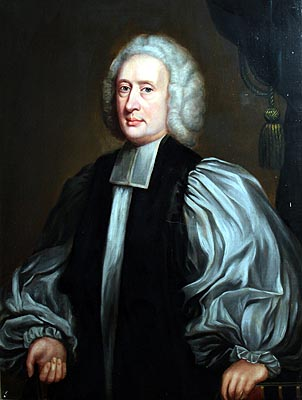
SERMON I.
PREACHED BEFORE THE INCORPORATED SOCIETY FOR THE PROPAGATION OF THE GOSPEL IN FOREIGN PARTS,
At their Anniversary Meeting in the Parish Church of St, Mary-le-Bow,
On Friday, February 16, 1738-9.
And this gospel of the kingdom shall be preached in all the world, for a witness unto all nations.—Matthew xxiv. 14.
The general doctrine of religion, that all things are under the direction of one righteous Governor, having been established by repeated revelations in the first ages of the world, was left with the bulk of mankind, to be honestly preserved pure and entire, or carelessly forgotten, or wilfully corrupted. And though reason, almost intuitively, bare witness to the truth of this moral system of nature, yet it soon appeared, that “they did not like to retain God in their knowledge,” Rom. i. 28, as to any purposes of real piety. Natural religion became gradually more and more darkened with superstition, little understood, less regarded in practice; and the face of it scarce discernible at all, in the religious establishments of the most learned, polite nations. And how much soever could have been done towards the revival of it by the light of reason, yet this light could not have discovered what so nearly concerned us, that important part in the scheme of this world which regards a Mediator; nor how far the settled constitution of its government admitted repentance to be accepted for remission of sins, after the obscure intimations of these things, from tradition, were corrupted or forgotten. One people, indeed, had clearer notices of them, together with the genuine scheme of natural religion preserved in the primitive and subsequent revelations committed to their trust; and were designed to be a witness of God, and a providence to the nations around them: but this people also had corrupted themselves and their religion to the highest degree that was consistent with keeping up the form of it.
In this state of things, when Infinite Wisdom saw proper, the general doctrine of religion was authoritatively republished in its purity; and the particular dispensation of Providence, which this world is under, manifested to all men, even “the dispensation of the grace of God towards us,” Eph. iii. 2, as sinful, lost creatures, to be recovered by repentance through a Mediator, who was “to make reconciliation for iniquity, and to bring in everlasting righteousness,” Dan. ix. 24, and at length established that new state of things foretold by the prophet Daniel, under the character of “a kingdom, which the God of heaven would set up, and which should never be destroyed,” Dan. ii. 44. This, including a more distinct account of the instituted means whereby Christ the Mediator would “gather together in one, the children of God that were scattered abroad,” John xi. 52, and conduct them to “the place he is gone to prepare for them,” John xiv. 2, 3; is the gospel of the kingdom, which he here foretells, and elsewhere commands, should “be preached in all the world, for a witness unto all nations; and it first began to be spoken by the Lord, and was confirmed unto us by them that heard him; God also bearing them witness, both with signs and wonders, and with divers miracles, and gifts of the Holy Ghost, according to his own will,” Heb. ii. 8, 4: by which means it was spread very widely among the nations of the world, and became a witness unto them.
When thus much was accomplished, as there is a wonderful uniformity in the conduct of Providence, Christianity was left with Christians, to be transmitted down pore and genuine, or to be corrupted and sunk; in like manner as the religion of nature had been left with mankind in general There was however this difference, that by an institution of external religion fitted for all men, (consisting in a common form of Christian, worship, together with a standing ministry of instruction and discipline,) it pleased God to unite Christians in communities or visible churches, and all along to preserve them, over a great part of the world; and thus perpetuate a general publication of the gospel. For these communities, which together make up the catholic visible church, are, First, The repositories of the written oracles of God: and in every age have preserved and published them in every country, where the profession of Christianity has obtained. Hence it has come to pass, and it is a thing very much to be observed in the appointment of Providence, that even such of these communities as, in a long succession of years, have corrupted Christianity the most, have yet continually carried, together with their corruptions, the confutation of them; for they have everywhere preserved the pure original standard of it, the Scripture, to which recourse might have been had, both by the deceivers and the deceived, in every successive age. Secondly, Any particular church, in whatever place established, is like “a city that is set on a hill, which cannot be hid,” Matt. v. 14, inviting all who pass by to enter into it. All persons to whom any notices of it come, have, in Scripture language, the “kingdom of God come nigh unto them.” They are reminded of that religion which natural conscience attests the truth of; and they may, if they will, be instructed in it more distinctly, and likewise in the gracious means whereby sinful creatures may obtain eternal life; that chief and final good, which all men, in proportion to their understanding and integrity, even in all ages and countries of the heathen world, were ever in pursuit of. And, lastly, Out of these churches have all along gone forth persons who have preached the gospel in remote places with greater or less good effect: for the establishment of any profession of Christianity, however corrupt, I call a good effect, whilst accompanied with a continued publication of the Scripture, notwithstanding it may for some time lie quite neglected.
From these things, it may be worth observing, by the way, appears the weakness of all pleas for neglecting the public service of the church. For though a man prays with as much devotion and less interruption at home, and reads better sermons there, yet that will by no means excuse the neglect of his appointed part in keeping up the profession of Christianity amongst mankind. And this neglect, were it universal, must be the dissolution of the whole visible church, i.e., of all Christian communities; and so must prevent those good purposes which were intended to be answered by them, and which they have all along answered over the world. For we see, that by their means the event foretold in the text, which began in the preaching of Christ and the apostles, has been carried on, more or less, ever since, and is still carrying on; these being the providential means of its progress. And it is, I suppose, the completion of this event which St. John had a representation of under the figure of “an angel flying in the midst of heaven, having the everlasting gospel to preach unto them that dwell on the earth, and to every nation, and kindred, and tongue, and people,” Rev. xiv. 6.
Our Lord adds in the text, that this should be “for a witness unto them;” for an evidence of their duty, and an admonition to perform it. But what would be the effect or success of the general preaching of the gospel, is not here mentioned. And therefore the prophecy of the text is not parallel to those others in Scripture, which seemed to foretell the glorious establishment of Christianity in the last days; nor does it appear that they are coincident, otherwise than as the former of these events must be supposed preparatory to the latter. Nay, it is not said here, that God “willeth all men should be saved, and come unto the knowledge of the truth,” 1 Tim. ii. 4, though this is the language of Scripture elsewhere. The text declares no more, than that it was the appointment of God, in his righteous government over the world, that “the gospel of the kingdom should be preached for a witness unto it.”
The visible constitution and course of nature, the moral law written in our hearts, the positive institutions of religion, and even any memorial of it, are all spoken of in Scripture under this or the like denomination: so are the prophets, apostles, and our Lord himself. They are all witnesses, for the most part unregarded witnesses, in behalf of God, to mankind. They inform us of his being and providence, and of the particular dispensation of religion which we are under; and continually remind us of them; and they are equally witnesses of these things, whether we regard them or not. Thus, after a declaration that Ezekiel should be sent with a Divine message to the children of Israel, it is added, “and they, whether they will hear, or whether they will forbear, for they are a rebellious house, yet shall know that there hath been a prophet among them,” Ezek. ii. 5, 7. And our Lord directs the seventy disciples, upon their departure from any city which refused to receive them, to declare, “notwithstanding, be ye sure of this, that the kingdom of God is come nigh unto you,” Luke x. 11. The thing intended in both these passages is that which is expressed in the text by the word “witness.” And all of them together evidently suggest thus much, that the purposes of Providence are carried on, by the preaching of the gospel, to those who reject it as well as to those who embrace it. It is indeed true, “God willeth that all men should be saved,” yet from the unalterable constitution of his government, the salvation of every man cannot but depend upon his behaviour, and therefore cannot but depend upon himself, and is necessarily his own concern, in a sense in which it cannot be another’s. All this the Scripture declares in a manner the most forcible and alarming: “Can a man be profitable unto God, as he that is wise may be profitable unto himself? Is it any pleasure to the Almighty that thou art righteous? or is it gain to him that thou makest thy ways perfect?” Job xxii, 2, 3. “If thou be wise, thou shalt be wise for thyself: but if thou scornest, thou alone shalt bear it,” Prov. ix. 12. “He that heareth, let him hear; and he that forbeareth, let him forbear,” Ezek. iii. 27. And again, “He that hath ears to hear, let him hear: but if any man be ignorant, i.e., wilfully, let him be ignorant,” 1 Cor. xiv. 38. To the same purpose are those awful words of the angel, in the person of him to whom “all judgment is committed,” John V. 22; “He that is unjust, let him be unjust still; and he that is filthy, let him be filthy still; and he that is righteous, let him be righteous still; and he that is holy, let him be holy still. And, behold, I come quickly; and my reward is with me, to give every man according as his work shall be,” Rev. xxii. 11, 12. The righteous government of the world must be carried on; and of necessity, men shall remain the subjects of it, by being examples of its mercy or of its justice. “Life and death are set before them, and whether they like shall be given unto them,” Eccl. XV. 17. They are to make their choice, and abide by it; but whichsoever their choice be, the gospel is equally a witness to them; and the purposes of Providence are answered by this witness of the gospel.
From the foregoing view of things, we should be reminded, that the same reasons which make it our duty to instruct the ignorant in the relation which the light of nature shows they stand in to God their Maker, and in the obligations of obedience, resignation, and love to him, which arise out of that relation, make it our duty likewise to instruct them in all those other relations which revelation informs us of, and in the obligations of duty which arise out of them. And the reasons for instructing men in both these, are of the very same kind as for communicating any useful knowledge whatever. God, if he had so pleased, could indeed miraculously have revealed every religious truth which concerns mankind, to every individual man; and so he could have every common truth; and thus have superseded all use of human teaching in either. Yet, he has not done this, but has appointed that men should be instructed by the assistance of their fellow-creatures in both. Further: though all knowledge from reason is as really from God, as revelation is, yet this last is a distinguished favour to us, and naturally strikes us with the greatest awe, and carries in it an assurance that those things which we are informed of by it, are of the utmost importance to us to be informed of. Revelation, therefore, as it demands to be received with a regard and reverence peculiar to itself, so it lays us under obligations, of a like peculiar sort, to communicate the light of it. Further still: it being an indispensable law of the gospel, that Christians should unite in religious communities, and these being intended for repositories[1] of the written “oracles of God,” for standing memorials of religion to unthinking men, and for the propagation of it in the world; Christianity is very particularly to be considered as a trust deposited with us in behalf of others, in behalf of mankind, as well as for our own instruction. No one has a right to be called a Christian, who doth not do somewhat in his station towards the discharge of this trust; who doth not, for instance, assist in keeping up the profession of Christianity where he lives. And it is an obligation bat little more remote, to assist in doing it in our factories abroad; and in the colonies to which we are related, by their being peopled from our own mother country, and subjects, indeed very necessary ones, to the same government with ourselves; and nearer yet is the obligation upon such persons, in particular, as have the interoourse of an advantageous commerce with them.
Of these our colonies, the slaves ought to be considered as inferior members, and therefore to be treated as members of them, and not merely as cattle or goods, the property of their masters. Nor can the highest property possible to be acquired in these servants, cancel the obligation to take care of their religious instruction. Despicable as they may appear in our eyes, they are the creatures of God, and of the race of mankind for whom Christ died: and it is inexcusable to keep them in ignorance of the end for which they were made, and the means whereby they may become partakers of the general redemption. On the contrary, if the necessity of the case requires that they may be treated with the very utmost rigour that humanity will at all permit, as they certainly are, and for our advantage made as miserable as they well can be in the present world; this surely heightens our obligation to put them into as advantageous a situation as we are able, with regard to another.
The like charity we owe to the natives; owe to them in a much stricter sense than we are apt to consider, were it only from neighbourhood and our having gotten possessions in their country. For incidental circumstances of this kind appropriate all the general obligations of charity to particular persons, and make such and such instances of it the duty of one man rather than another. We are most strictly bound to consider these poor uninformed creatures as being in all respects of one family with ourselves, the family of mankind, and instruct them in our “common salvation,” Jude 3; that they may not pass through this stage of their being like brute beasts, but be put into a capacity of moral improvements, how low soever they must remain as to others, and so into a capacity of qualifying themselves for a higher state of life hereafter.
All our affairs should be carried on in the fear of God, in subserviency to his honour and the good of mankind. And thus navigation and commerce should be consecrated to the service of religion, by being made the means of propagating it in every country with which we have any intercourse. And the more widely we endeavour to spread its light and influence, as the fore-mentioned circumstances, and others of the like kind, open and direct our way, the more faithful shall we be judged in the discharge of that trust[2] which is committed to us as Christians, when our Lord shall require an account of it.
And it may be some encouragement to cheerful perseverance in these endeavours, to observe, not only that they are our duty, but also that they seem the means of carrying on a great scheme of Providence, which shall certainly be accomplished. For “the everlasting gospel shall be preached to every nation,” Rev. xiv. 6; “and the kingdoms of this world shall become the kingdoms of our Lord, and of his Christ,” Rev. xi. 15.
However, we ought not to be discouraged in this good work, though its future success were less clearly foretold; and though its effect now in reforming mankind appeared to be as little as our adversaries pretend. They indeed, and perhaps some others, seem to require more than either experience or Scripture give ground to hope for, in the present course of the world. But the bare establishment of Christianity in any place, even the external form and profession of it, is a very important and valuable effect. It is a serious call upon men to attend to the natural and the revealed doctrine of religion. It is a standing publication of the gospel, and renders it a witness to them; and by this means the purposes of Providence are carrying on, with regard to remote ages, as well as to the present. “Cast thy bread upon the waters: for thou shalt find it after many days. In the morning sow thy seed, and in the evening withhold not thine hand; for thou knowest not whether shall prosper, either this or that, or whether they both shall be alike good,” Eccles. xi. 1, 6. We can look but a very little way into the connections and consequences of things: our duty is to spread the incorruptible seed as widely as we can; and leave it to “God to give the increase,” 1 Cor. iii. 6. Yet thus much we may be almost assured of, that the gospel, wherever it is planted, will have its genuine effect upon some few; upon more, perhaps, than are taken notice of in the hurry of the world. There are, at least, a few persons in every country and successive age, scattered up and down, and mixed among the rest of mankind; who, not being corrupted past amendment, but having within them the principles of recovery, will be brought to a moral and religious sense of things, by the establishment of Christianity where they live; and then will be influenced by the peculiar doctrines of it, in proportion to the integrity of their minds, and to the clearness, purity, and evidence, with which it is offered them. Of these our Lord speaks in the parable of the sower, “as understanding the word, and bearing fruit, and bringing forth, some an hundred fold, some sixty, some thirty,” Matt. xiii. 23. One might add that these persons, in proportion to their influence, do at present better the state of things; better it even in the civil sense, by giving some check to that avowed profligateness, which is a contradiction to all order and government, and, if not checked, must be the subversion of it.
These important purposes, which are certainly to be expected from the good work before us, may serve to show how little weight there is in that objection against it, from the want of those miraculous assistances with which the first preachers of Christianity proved its truth. The plain state of the case is, that the gospel, though it be not in the same degree a witness to all who have it made known to them; yet in some degree is so to all. Miracles, to the spectators of them, are intuitive proofs of its truth: but the bare preaching of it is a serious admonition to all who hear it, to attend to the notices which God has given of himself by the light of nature; and, if Christianity be preached with its proper evidence, to submit to its peculiar discipline and laws: if not, to inquire honestly after its evidence in proportion to their capacities. And there are persons of small capacities for inquiry and examination, who yet are wrought upon by it to “deny ungodliness and worldly lusts, and live soberly, righteously, and godly in this present world,” Tit. ii. 12, 13, in expectation of a future judgment by Jesus Christ. Nor can any Christian who understands his religion object that these persons are Christians without evidence; for he cannot be ignorant who has declared, that “if any man will do his will, he shall know the doctrine, whether it be of God,” John vii. 1 7. And, since the whole end of Christianity is to influence the heart and actions, were an unbeliever to object in that manner, he should be asked, whether he would think it to the purpose to object against persons of like capacities, that they are prudent without evidence, when, as is often the case, they are observed to manage their worldly affairs with discretion.
The design before us being therefore in general unexceptionably good, it were much to be wished, that serious men of all denominations would join in it. And let me add, that the foregoing view of things affords distinct reasons why they should. For, first, by so doing, they assist in a work of the most useful importance, that of spreading over the world the Scripture itself, as a Divine revelation; and it cannot be spread under this character, for a continuance, in any country, unless Christian churches be supported there, but will always, more or less, so long as such churches subsist: and, therefore, their subsistence ought to be provided for. In the next place, they should remember, that if Christianity is to be propagated at all, which they acknowledge it should, it must be in some particular form of profession. And though they think ours liable to objections, yet it is possible they themselves may be mistaken; and whether they are or no, the very nature of society requires some compliance with others. And whilst, together with our particular form of Christianity, the confessed standard of Christian religion, the Scripture, is spread; and especially whilst every one is freely allowed to study it, and worship God according to his conscience; the evident tendency is, that genuine Christianity will be understood and prevail. Upon the whole, therefore, these persons would do well to consider how far they can with reason satisfy themselves in neglecting what is certainly right, on account of what is doubtful whether it be wrong; and when the right is of so much greater consequence one way, than the supposed wrong can be on the other.
To conclude: atheistical immorality and profaneness, surely, is not better in itself, nor less contrary to the design of revelation, than superstition. Nor is superstition the distinguishing vice of the present age, either at home or abroad. But if our colonies abroad are left without a public religion, and the means of instruction, what can be expected, but that from living in a continual forgetfulness of God, they will at length cease to believe in him, and so sink into stupid atheism? And there is too apparent danger of the like horrible depravity at home, without the like excuse for it. Indeed, amongst creatures naturally formed for religion, yet so much under the powers of imagination, so apt to deceive themselves, and so liable to be deceived by others, as men are, superstition is an evil which can never be out of sight. But even against this, true religion is a great security, and the only one. True religion takes up that place in the mind which superstition would usurp, and so leaves little room for it; and likewise lays us under the strongest obligations to oppose it. On the contrary, the danger of superstition cannot but be increased by the prevalence of irreligion, and by its general prevalence the evil will be unavoidable. For the common people wanting a religion, will of course take up with almost any superstition which is thrown in their way; and, in process of time, amidst the infinite vicissitudes of the political world, the leaders of parties will certainly be able to serve themselves of that superstition, whatever it be, which is getting ground; and will not fail to carry it on to the utmost length their occasions require. The general nature of the thing shows this, and history and fact confirm it. But what brings the observation home to ourselves is, that the great superstition of which this nation, in particular, has reason to be afraid, is imminent; and the ways in which we may very supposably be overwhelmed by it, obvious. It is, therefore, wonderful, those people, who seem to think there is but one evil in life, that of superstition, should not see that atheism and profaneness must be the introduction of it. So that, in every view of things, and upon all accounts, irreligion is at present our chief danger. Now the several religious associations among us, in which many good men have of late united, appear to be providentially adapted to this present state of the world. And as all good men are equally concerned in promoting the end of them, to do it more effectually, they ought to unite in promoting it; which yet is scarce practicable upon any new models, and quite impossible upon such as every, one would think unexceptionable. They ought therefore to come into those already formed to their hands, and even take advantage of any occasion of union, to add mutual force to each other’s endeavours in furthering their common end, however they may differ as to the best means, or anything else subordinate to it. Indeed there are well-disposed persons, who much want to be admonished, how dangerous a thing it is to discountenance what is good, because it is not better, and hinder what they approve, by raising prejudices against some under part of it. Nor can they assist in rectifying what they think capable of amendment, in the manner of carrying on these designs, unless they will join in the designs themselves, which they must acknowledge to be good and necessary ones. For what can be called good and necessary by Christians, if it be not so to support Christianity where it must otherwise sink, and propagate it where it must otherwise be unknown; to restrain abandoned, bare-faced vice, by making useful examples, at least of shame, perhaps of repentance; and to take care of the education of such children as otherwise must be even educated in wickedness, and trained up to destruction? Yet good men, separately, can do nothing proportionable to what is wanting in any of these ways; but their common, united endeavours, may do a great deal in all of them.
And besides the particular purposes which these several religious associations serve, the more general ones, which they all serve, ought not to be passed over. Everything of this kind is, in some degree, a safeguard to religion—an obstacle, more or less, in the way of those who want to have it extirpated out of the world. Such societies also contribute more especially towards keeping up the face of Christianity among ourselves; and by their obtaining here, the gospel is rendered more and more a witness to us. And if it were duly attended to, and had its genuine influence upon our minds, there would be no need of persuasions to impart the blessing; nor would the means of doing it be wanted. Indeed, the present income of this Society, which depends upon voluntary contributions, with the most frugal management of it, can in no wise sufficiently answer the bare purposes of our charter; but the nation, or even this opulent city itself, has it in its power to do so very much more, that I fear the mention of it may be thought too severe a reproof, since so little is done. But if the gospel had its proper influence upon the Christian world in general, as it is the centre of trade and the seat of learning, a very few ages, in all probability, would settle Christianity in every country, without miraculous assistances. For scarce anything else, I am persuaded, would be wanting to effect this, but laying it before men in its divine simplicity, together with an exemplification of it in the lives of Christian nations. “The unlearned and unbelievers, falling down on their faces, would worship God, and report that God is in us of a truth,” 1 Cor. xiv.
- Page 182.
- Page 186.
 Pastor Tom's Community