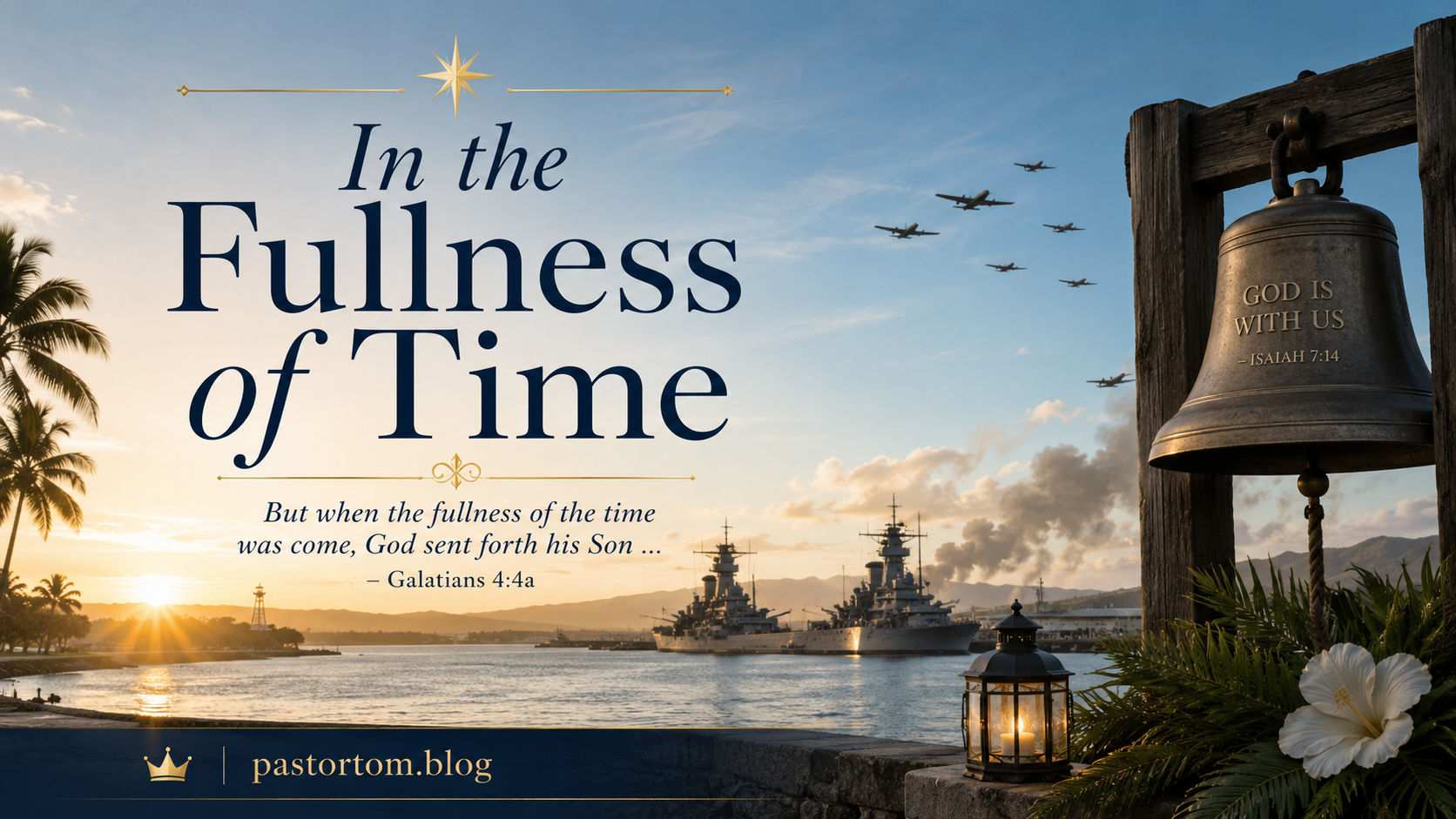
In the Fullness of Time
“But when the fulness of the time was come, God sent forth his Son …”
— Galatians 4:4a
The sky was blue.
The Honolulu Star-Bulletin for December 7, 1941, carried notices of Christmas events and parties planned throughout Honolulu. Many were arranged especially for servicemen who would be away from home through the holidays.
That morning, some of those young men may have read the paper, marked their calendars, and begun to anticipate open homes, church gatherings, music, food, friendship, and the smells of Christmas. Perhaps they were lonely. Perhaps they were homesick. Perhaps they comforted themselves with the thought that, if they had to be away from family, Hawaii was not the worst place to be.
It was Sunday.
Some were still sleeping. Some were finishing coffee. Some were on duty. Others were preparing for worship, work, rest, or recreation.
Then, at about 7:55 a.m., the first wave of Japanese aircraft struck U.S. military and naval installations on Oahu. The attack came without warning. A second wave followed at 8:40 a.m. Before the morning was over, the world had changed.
They were caught off guard.
But God was not.
Nor was God absent.
That does not mean God caused the bombs to fall. It does not mean every sorrow is secretly good. It does not mean evil is anything less than evil, or that grief should be explained away with religious slogans.
It means this: history never happens outside the reach of God.
Paul wrote that “when the fulness of the time was come, God sent forth his Son.” Christmas did not arrive in a sentimental world. Christ was born into occupation, taxation, displacement, violence, empire, fear, and longing. The manger was not placed in a safe world. It was placed in the real world.
The bells of Christmas ring in a world where people still make plans that are interrupted, still prepare celebrations that are overshadowed, still wake up to news they never expected, still discover that life can change before the day is half spent.
And yet, God comes.
God comes in the fullness of time.
God comes not as an escape from history, but as Lord within history. God comes not to deny human pain, but to enter it. God comes not to promise that we will never be surprised, but to assure us that heaven is never surprised.
The Christmas announcement is not that the world is calm.
The Christmas announcement is that God is with us.
When calendars are full, God is with us.
When plans are shattered, God is with us.
When history trembles, God is with us.
When grief interrupts celebration, God is with us.
When the sky is blue and danger is near, God is with us.
Everything within God’s care takes place in the fullness of time, where God is actively working out purposes deeper than our sight and stronger than our fear. God may not bring about every disaster, but Christmas reminds us that God is present in the midst of every disaster.
The Son has been sent.
The Word has become flesh.
The Light shines in the darkness.
And the darkness has not overcome it.
 Pastor Tom's Community
Leave a comment