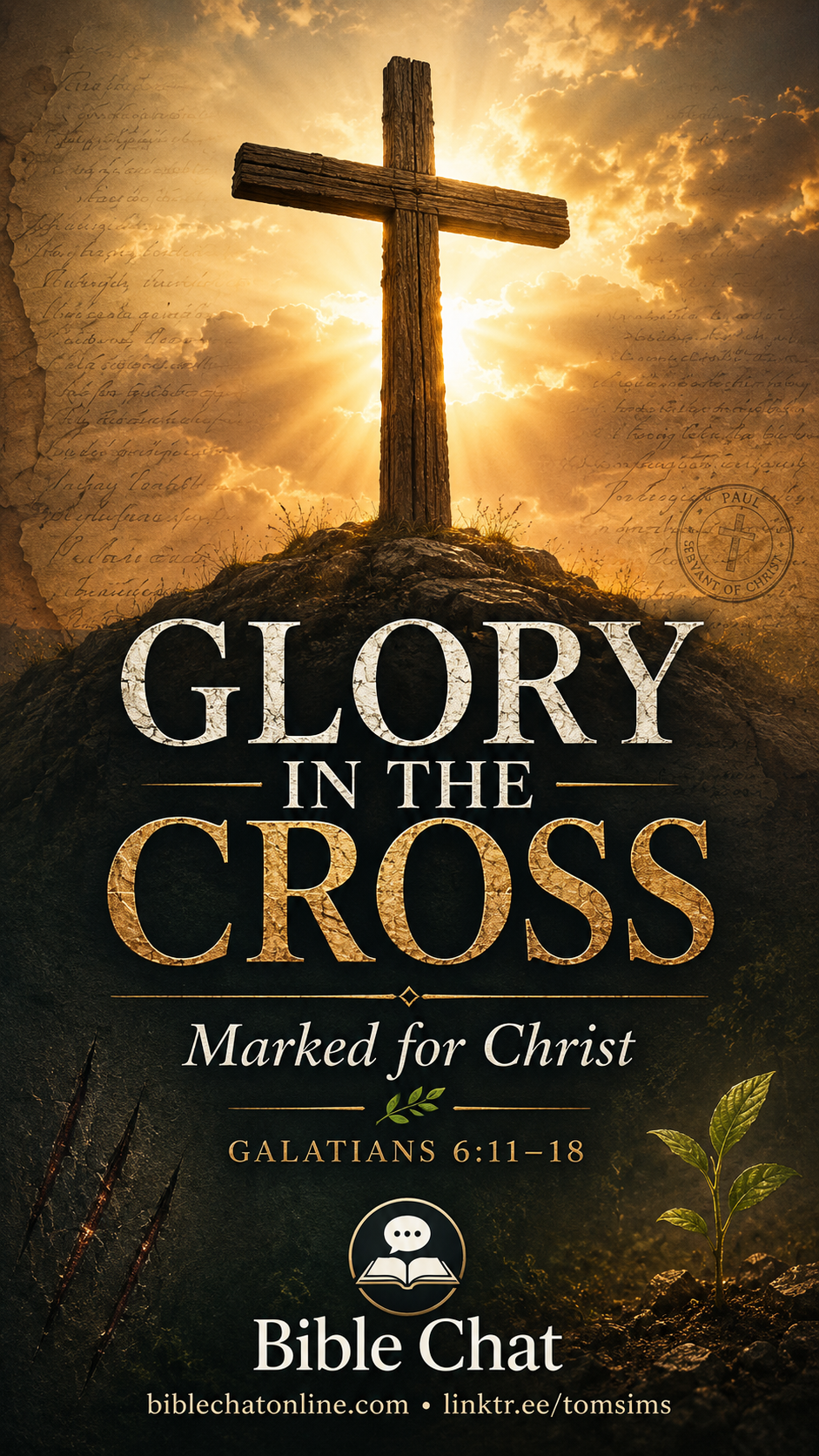
“May I never boast of anything except the cross of our Lord Jesus Christ, by which the world has been crucified to me, and I to the world.” — Galatians 6:14
Paul comes to the end of Galatians with urgency.
He has dictated much of the letter, as was common in his day, but now he takes the pen in his own hand.
“See what large letters I make when I am writing in my own hand!”
Maybe his eyes were weak. Maybe he wanted them to know the final words were personally written. Or maybe, in our modern phrasing, Paul was writing in bold print. He was raising his voice.
This mattered.
Read and Listen More at Bible Chat Online.
The issue was circumcision, but circumcision was not the deepest issue. The deeper issue was pressure, performance, fear, boasting, and the temptation to substitute religious marking for gospel transformation.
Some were compelling Gentile believers to be circumcised. Paul says they were doing it to “make a good showing in the flesh.” They wanted religious evidence they could point to. They wanted visible results. They wanted to boast in someone else’s flesh.
And they wanted to avoid persecution for the cross of Christ.
That is a dangerous religious impulse: to impose burdens on others in order to protect ourselves.
Paul will have none of it.
He says, in effect, “You want to boast? I will tell you what I boast in. I boast in the cross.”
Not my pedigree.
Not my performance.
Not my power.
Not my religious résumé.
Not my ability to control other people.
Not my record of outward marks.
“May I never boast of anything except the cross of our Lord Jesus Christ.”
The cross ends our bragging.
At the cross, all human pride collapses. We cannot stand there and boast about our goodness. We cannot stand there and boast about our superiority. We cannot stand there and boast about how many people we have made conform to our expectations.
At the cross, we see both the severity of sin and the magnificence of grace.
We see the worst humanity can do and the best God can give.
We see hatred answered by forgiveness.
We see violence answered by self-giving love.
We see death become the doorway to life.
Paul says that through the cross, “the world has been crucified to me, and I to the world.”
That includes the world’s approval.
That includes the world’s applause.
That includes the religious world’s obsession with appearances.
That includes the need to be admired, defended, justified, and praised.
Paul has died to that old system of measuring life. And that old system has died to him.
Then he says something that gathers up the whole letter:
“For neither circumcision nor uncircumcision is anything; but a new creation is everything!”
That is the heart of it.
The question is not whether you have the right outward badge.
The question is not whether you fit into someone else’s religious category.
The question is not whether somebody can boast about you as their accomplishment.
The question is this:
Has Christ made you new?
New creation is everything.
Not cosmetic religion.
Not spiritual performance.
Not pressure from people who are trying to avoid their own suffering.
Not outward conformity without inward transformation.
New creation.
A new heart.
A new allegiance.
A new freedom.
A new way of seeing God, yourself, others, and the world.
Paul ends with peace and mercy for those who walk by this rule. Then he says, “From now on, let no one make trouble for me; for I carry the marks of Jesus branded on my body.”
Others wanted marks in the flesh.
Paul already had marks.
Scars.
Wounds.
Evidence of suffering.
Signs that he had followed Christ into costly obedience.
He says, “You want to talk about bodily marks? I carry the marks of Jesus.”
There is a difference between being marked by religious pressure and being marked by faithful discipleship.
There is a difference between being branded by human systems and being shaped by the cross of Christ.
There is a difference between carrying the expectations of others and carrying the grace of Jesus in your spirit.
So Paul closes where all gospel preaching must close:
“May the grace of our Lord Jesus Christ be with your spirit, brothers and sisters. Amen.”
Not law as a burden.
Not flesh as a trophy.
Not religion as performance.
Grace.
Grace with your spirit.
Grace deep enough to free you.
Grace strong enough to mark you.
Grace powerful enough to make you new.
Bonus: The Haunting of Herod: When Power Cannot Silence Truth
Herod thought John was dead.
But when Herod heard reports about Jesus, John’s voice came back.
Not physically.
Not literally.
But in memory, conscience, and fear.
Truth has a way of returning.
We may silence the messenger, avoid the conversation, change the subject, bury the evidence, or distract ourselves with noise. But truth is persistent.
Herod was haunted because he had heard enough to know better.
He admired John but would not obey the God John proclaimed.
John died free.
Herod lived haunted.
That is the warning.
Jesus still calls us beyond fascination into surrender, beyond regret into repentance, beyond fear into freedom.
Matthew 14:1–13
Herod heard reports about Jesus, but instead of wonder, he felt fear.
“This is John the Baptist,” he said. “He has been raised from the dead.”
Herod had tried to silence John, but he could not silence the truth John had spoken. He could behead the prophet, but he could not behead the truth. This message explores what happens when truth confronts power, when conscience is silenced but not satisfied, and when a person has enough spiritual curiosity to be disturbed by God but not enough surrender to repent.
John loses his head.
Herod loses his soul.
Jesus receives the news, withdraws in holy grief, and continues the work of the Kingdom.
Main idea:
When truth confronts power, the faithful may suffer, but the Kingdom does not die. The real tragedy is not that John lost his head, but that Herod lost his soul while trying to save face.
Read the full Substack reflection and subscriber study materials here:
https://tomsims.substack.com/p/the-haunting-of-herod
Join The Fellowship of Joy discussion of this message here:
https://www.facebook.com/groups/fellowshipofjoy/posts/10167691144434409
More from Tom Sims:
https://linktr.ee/tomsims
Discussion Questions:
- What is the difference between being troubled by truth and being transformed by truth?
- Why do you think Herod was fascinated by John but unwilling to repent?
- Where do we see people “saving face” at the expense of doing what is right?
- What does it mean that Herod’s banquet serves death, while Jesus’ table serves life?
- When grief, injustice, or confusion comes, what would it mean to “go tell Jesus”?
Key lines from the message:
Herod could behead the prophet, but he could not behead the truth.
Herod was not haunted by John’s ghost. He was haunted by his own conscience.
A ruler can still be ruled. A king can still be a puppet.
Power does not make us free. Sometimes power only gives our bondage a larger stage.
When you do not know what else to do with your grief, go tell Jesus.
#Matthew14 #JohnTheBaptist #TheHauntingOfHerod #BibleChat #FellowshipOfJoy #Sermon #KingdomOfGod #Repentance #TruthAndPower #Jesus
 Pastor Tom's Community
Leave a comment