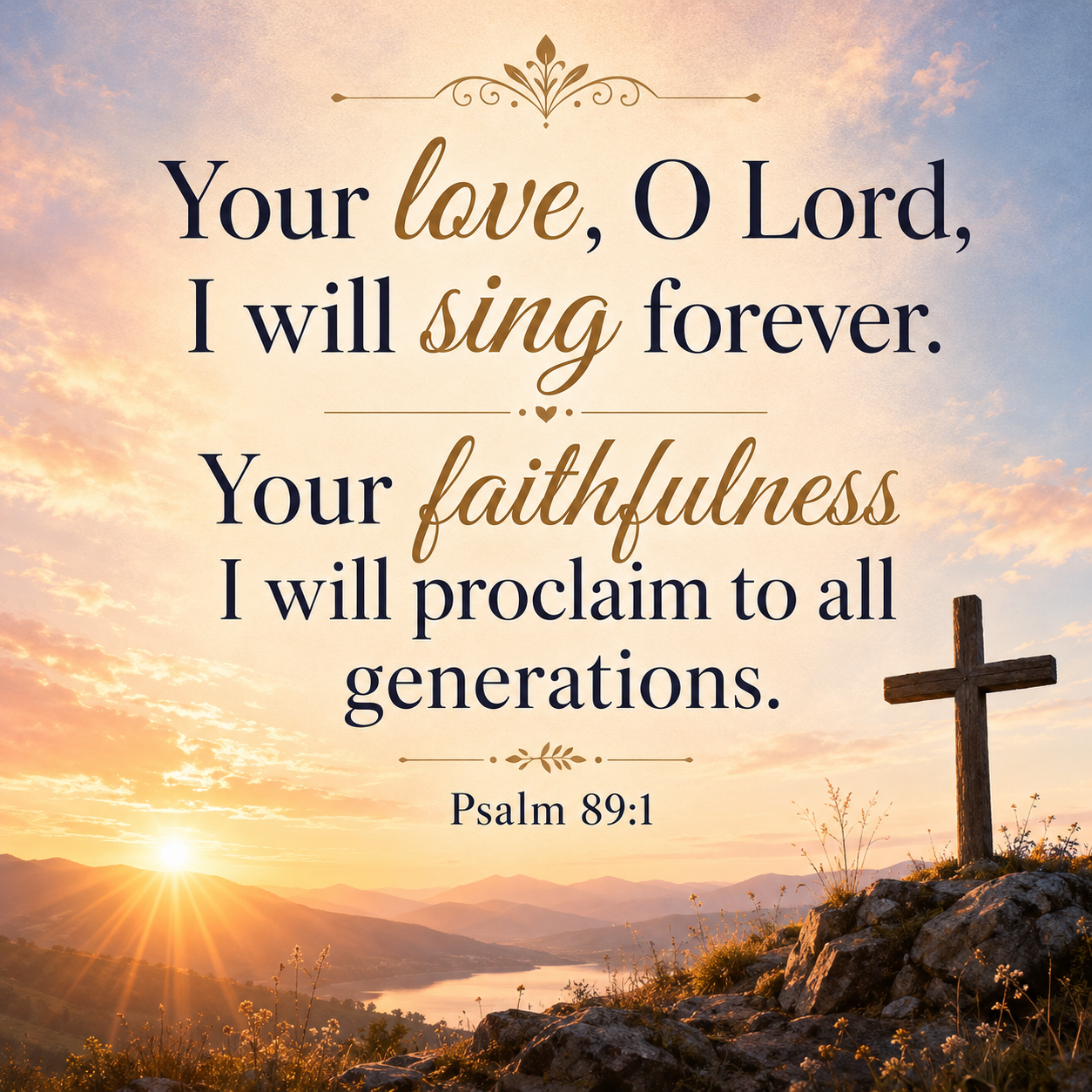
A Reflection on Psalm 89:1–2
“I will sing of your steadfast love, O LORD, forever;
with my mouth I will proclaim your faithfulness to all generations.”
Some translations render the psalmist’s opening words in Psalm 89 as:
“I will sing of your steadfast love, O LORD, forever;
with my mouth I will proclaim your faithfulness to all generations.”
That is strong and beautiful.
But there is another way of hearing it that moves me even more deeply:
I will sing your love.
Not merely about your love.
Not merely because of your love.
Not merely in response to your love.
I will sing your love.
The love of God becomes the song itself.
The psalmist gives a reason:
“With my mouth I will proclaim your faithfulness to all generations.”
That raises a question: What is faithfulness in relation to love? And what is love in relation to faithfulness?
In the Hebrew imagination, love is not merely sentiment. It is not a passing feeling. The word often behind this idea is chesed — covenant love, steadfast love, faithful lovingkindness.
It is love that keeps showing up.
It is love that binds itself to promise.
It is love that does not evaporate when circumstances change.
It is love with endurance in it.
We have entered into a covenant relationship with God, and we bring to that covenant our imperfect promises, our uneven faithfulness, our stumbling devotion. But God brings something greater. God brings divine faithfulness — a faithfulness that does not merely match ours, but exceeds it.
That is why the psalmist can sing.
He says this love is proclaimed “to all generations,” from age to age. There are the ages of the earth. There are the ages of human history. There are the generations before us and after us.
But there is also my age to age.
There is the long walk of my own life.
And as I look back over that walk, every step has carried some evidence of the presence of God’s love. Sometimes I recognized it immediately. Sometimes I only saw it later. Sometimes I doubted it while I was walking through the valley. But looking back, I can say:
God’s love was there.
So I sing it.
My mouth proclaims it.
I sing love.
Bono once suggested that every love song is, in some deep way, a song about God. I think there is something profoundly true about that. Every genuine longing for love, every aching desire to be known, held, forgiven, restored, and cherished, points beyond itself.
The psalmist says, in effect:
I am persuaded that your love is established forever.
Your faithfulness is fixed in the heavens.
That makes God’s love more than a mood.
It is an established reality.
It is a strong commitment.
It brings stability.
So it is with covenant love.
It is promise.
It is nature.
It becomes conviction.
And then, over time, conviction becomes confirmation.
We sing it because it has gone to our hearts.
We sing it because it has emerged in our experience.
We sing it because life has tested it, and God has not failed.
The love of God is compounded in our lives. It grows in meaning as we grow in years. What we once believed by faith, we later recognize by memory.
We are in the middle of forever now.
Forever is not only something waiting beyond death. Forever has already begun. We wake up inside it each morning when we wake up to the love of God again.
That is why Frederick M. Lehman’s great hymn, “The Love of God,” resonates so deeply with Psalm 89. Lehman captured something of the psalmist’s wonder — the immeasurable, enduring, uncontainable love of God. He gave us phrases like “measureless and strong” and imagined a love too vast for ocean, sky, quill, or human language to fully describe.
That is Psalm 89 language.
That is covenant-love language.
That is the song of the saints and angels.
And that is the song we are invited to sing today:
Your love, O Lord, I will sing forever.
Your faithfulness I will proclaim to all generations.
God bless you.

 Pastor Tom's Community
Leave a comment