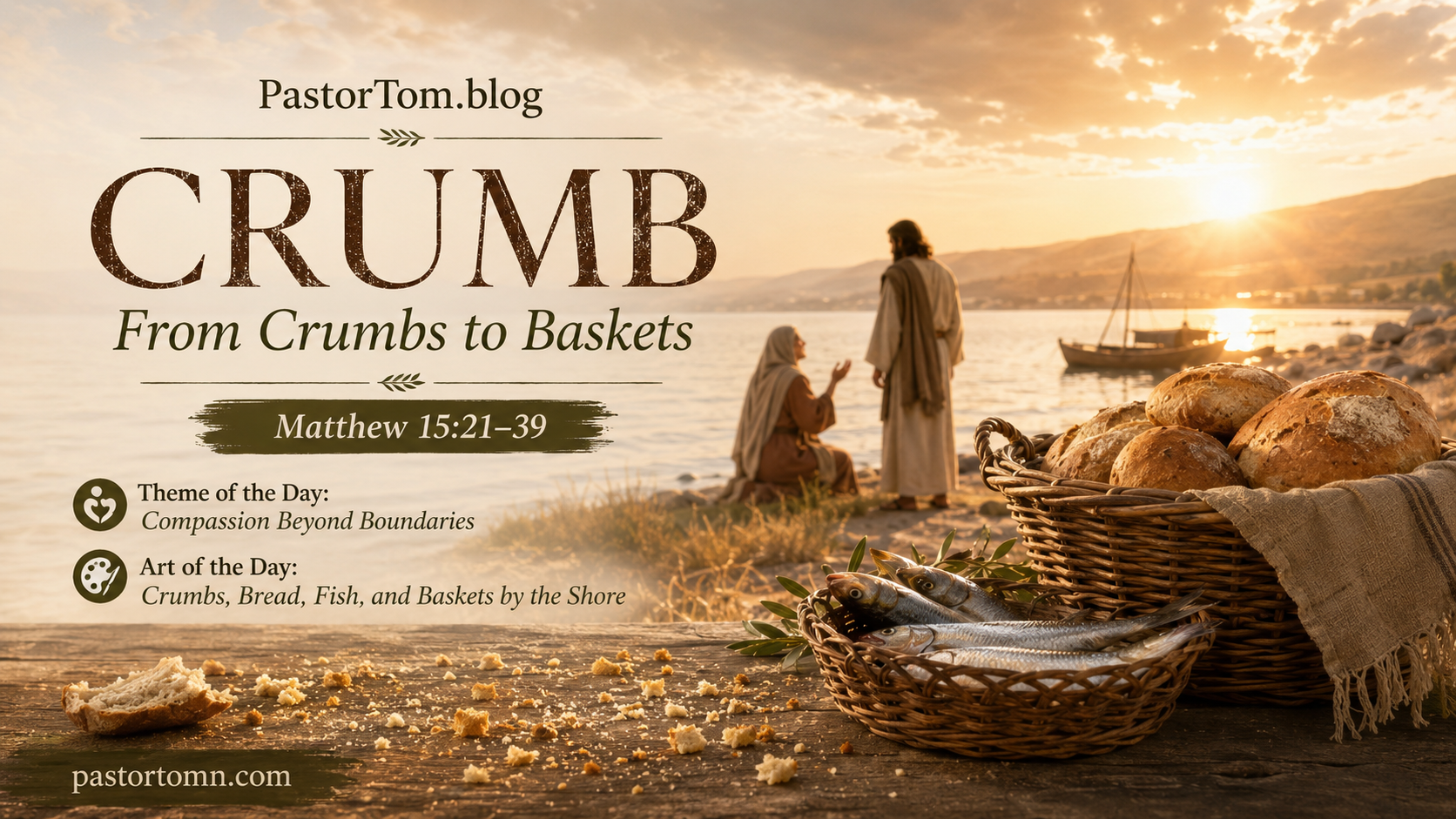
Matthew 15:21–39 and the Church’s Mission to the Outsider
Matthew 15:21–39 is not merely a story about one desperate mother and one miraculous meal. It is a passage about boundaries, faith, compassion, and the widening table of Jesus.
Jesus withdraws to the region of Tyre and Sidon. This is not the heartland of Galilean Jewish life. It is border territory, associated with Gentile peoples and older biblical memories. Matthew identifies the woman who approaches Jesus as “Canaanite,” a term full of theological and historical weight. In Israel’s Scriptures, Canaanite religion and culture are frequently criticized as corrupting influences. Yet this woman, carrying all that outsider status, comes to Jesus crying, “Have mercy on me, Lord, Son of David; my daughter is tormented by a demon.”
The disciples hear annoyance.
Jesus hears faith.
Or perhaps more precisely, Jesus draws faith into the open where everyone else can hear it.
The disciples say, “Send her away.” She keeps coming. Jesus speaks of children’s bread and dogs beneath the table. It is a hard word, and we should not soften it too quickly. But the woman answers with astonishing spiritual insight:
“Yes, Lord, yet even the dogs eat the crumbs that fall from their masters’ table.”
She does not deny the priority of Israel. She does not demand status. She trusts abundance.
She believes that crumbs from the table of Jesus are enough.
Then Jesus says what may have shocked the disciples as much as anything else in the story:
“Woman, great is your faith!”
Great faith.
Not from one of “our people.”
Not from one of the insiders.
Not from the expected source.
Great faith from the Canaanite woman.
That should trouble the contemporary church in all the right ways.
Who is the Canaanite woman among us?
Who do we experience as an annoyance, interruption, or distraction?
Who are the people whose cries we would rather not hear because they complicate our mission, our schedule, our assumptions, or our theology?
Who are the outsiders in our community — religious outsiders, cultural outsiders, political outsiders, economic outsiders, wounded outsiders, morally complicated outsiders, people with other spiritual vocabularies, people whose stories do not fit neatly into our categories?
And would we be offended if Jesus called their faith “great”?
Would we be offended if Jesus said that about a Wiccan neighbor who keeps crying out for mercy? About a Muslim parent praying desperately for a child? About a person who has left church but still reaches toward God in pain? About someone whose life or language does not sound like ours, but whose hunger for mercy is real?
This does not mean all faith claims are the same. It does not mean discernment disappears. It does mean we had better be humble about where God may already be at work.
Matthew’s Gospel begins with Gentile women in Jesus’ genealogy and ends with Jesus sending his disciples to make disciples of all nations. This encounter is not a detour. It is a preview.
After the woman’s daughter is healed, Matthew widens the scene. Great crowds come to Jesus, bringing the lame, the blind, the maimed, the mute, and many others. They put them at his feet, and he heals them. Then Jesus feeds the 4,000 with seven loaves and a few small fish.
The movement is from crumbs to baskets.
The mercy given to one outsider becomes a vision of healing for crowds and bread in the wilderness.
For the church, this passage asks whether we are participating in the compassion of Jesus or merely managing access to him.
Some people come to Jesus on their own two feet. Others are carried by the faith, prayers, patience, and compassion of others. The question for those of us who count ourselves among the disciples is this: what role will we play in bringing them to Jesus and receiving them into our company?
Will we send them away?
Will we resent their cries?
Will we guard the table?
Or will we discover that the table is wider than we thought?
Focus Questions
- How does this passage apply to the contemporary church’s mission, outreach, and hospitality?
- Where are we tempted to treat someone’s cry for mercy as an annoyance or distraction?
- Who are the “Canaanite women” in our community — the outsiders, outcasts, religiously suspect, or socially inconvenient people we are tempted not to hear?
- Where might Jesus be recognizing “great faith” outside our familiar circles?
- Would we be insulted, confused, or challenged if Jesus praised the faith of someone we considered spiritually outside — a Wiccan, Muslim, atheist, doubter, critic, or wounded former church member?
- What pockets of faith, hunger, prayer, compassion, or spiritual longing exist in our neighborhoods among people who are not “our people”?
- How might our outreach change if we began by looking for where God is already stirring hunger and faith, rather than assuming we arrive as the only people with anything to offer?
- Are we helping people get to the feet of Jesus, or are we protecting ourselves from the inconvenience of their need?
- What are the “seven loaves and a few small fish” already in our hands for the work of compassion?
- What would it mean for our church to move from crumbs to baskets?
Read the full Substack reflection and sermon material:
https://tomsims.substack.com/p/crumb-from-crumbs-to-baskets

 Pastor Tom's Community
Leave a comment