A Pastoral Reflection

Do I Know My Neighbor?
When someone asked Jesus, “Who is my neighbor?” Jesus told a story.
Stories have a way of reaching places in us that explanations cannot. They move past our defenses. They settle into memory. They speak to the heart while the mind is still trying to organize the facts.
Jesus told the story we know as the Good Samaritan.
I do not need to recount every detail. You know the road. You know the wounded man. You know the people who saw him, passed him by, or stopped to help.
Then Jesus asked:
“Which of these three proved to be a neighbor?”
The original question was, “Who is my neighbor?”
Jesus answered by asking, in effect, “Who acted like one?”
He did not define the limits of neighborliness. He described the practice of neighboring.
That is a big, fat, hairy deal.
We often want categories. We want to know who qualifies for our concern, our compassion, our time, and our resources.
Jesus moves us away from categories and toward relationships.
We ask, “Who is my neighbor?”
Jesus asks, “Who will you become?”
A Dream That Asked a Question
I recently had a dream about a neighbor.
I wrote about it on another platform, but the question it left with me belongs here as well.
I would not suggest that the dream was prophetic. I am not trying to attach some mystical certainty to it.
Sometimes dreams do not answer questions.
Sometimes they ask them.
In the dream, I was busy. I moved from place to place. I helped during an emergency involving a neighbor, and then I went about my business.
Later, someone asked whether that neighbor had died.
I realized I did not know.
I had never checked.
Worse than that, I did not really know the neighbor’s name.
When I woke up, one question stayed with me:
Do I know my neighbor?
And another followed close behind:
Can I love my neighbor if I do not know my neighbor?
Loving in the Abstract and the Concrete
Years ago, I heard a story about a preacher who frequently talked about loving one’s neighbor.
One day, he had just finished laying fresh concrete along his walkway. He stood back admiring his work when a child came running along and stepped directly into it, leaving footprints behind.
The preacher became angry and started yelling.
His wife reminded him, “You are always talking about loving your neighbor.”
He replied, “I love my neighbor in the abstract, but not in my concrete.”
That is the challenge, is it not?
It is possible to love humanity in theory while becoming irritated with actual humans.
We may love the world while avoiding the people next door.
We may affirm compassion as a principle but resist the inconvenience of practicing it.
Jesus continually brings love out of the abstract and into the concrete circumstances of daily life.
The Difference Was Attention
The priest saw the wounded man.
The Levite saw him.
The Samaritan saw him.
The difference was not eyesight.
It was attention.
The Samaritan allowed what he saw to interrupt his plans.
That is often where neighboring begins: with a willingness to be interrupted.
This morning, I intended to get directly to work. I had a to-do list. I had writing to complete, letters to compose, and administrative tasks waiting for me.
Then the dog looked at me with those longing eyes that said it was time to go outside.
My coffee seemed to ask whether it might taste better under a tree.
So I went outside.
While I was sitting there, I met two neighbors I had not met before. We had a lovely conversation.
Later, my wife interrupted me with a chore. I decided to embrace it rather than resent it. For one thing, she is my wife, and I love her. For another, the interruption might contain an opportunity.
It did.
I came away with another story.
Perhaps compassion begins where distraction ends.
When Ministry Becomes an Excuse
This gets personal for me.
In my dream, I was busy doing ministry.
Meanwhile, my neighbor might have been dying.
There is a danger that we can become so occupied serving God that we overlook the people God has already placed beside us.
Church activity is not always neighborly love.
Religious work can become an excuse for avoiding human need.
We can become busy discussing compassion, organizing compassion, teaching compassion, and planning ministries of compassion while failing to notice the person standing within arm’s reach.
That does not mean organized ministry is unimportant. It means ministry must never become a substitute for love.
I recently rode through the neighborhood where I once served as pastor. I have sometimes wondered whether we made a lasting difference there.
Then I remembered the names.
I remembered business owners, families, neighborhood residents, people who came and went, and people who never attended our church but still recognize me in public and call me Pastor Tom.
We did not know everyone.
But we were neighbors to some.
That brought a smile to my heart.
Geography Is Not the Whole Story
Our neighbor is not limited to the person who lives next door.
Jesus crossed social, cultural, religious, and ethnic boundaries.
He encountered Samaritans, tax collectors, lepers, widows, immigrants, outcasts, and people considered morally or ceremonially unclean.
He spoke with the woman at the well.
He responded to the Syrophoenician woman pleading for her daughter.
He repeatedly went toward people others avoided.
Our neighborhood includes people who may never live on our street.
Sometimes we encounter them because we deliberately cross a boundary.
Neighboring is often a combination of proximity and opportunity.
Yet geography remains a beginning.
How can I claim to love the nations while ignoring the family across the street?
How can I pray for strangers around the world while remaining indifferent to the loneliness next door?
We do not neglect one in order to care for the other.
Love expands outward, but it often begins nearby.
Ordinary Acts of Neighboring
Loving one’s neighbor usually does not require a miracle.
It does not always involve dramatic evangelism.
It is often remarkably ordinary.
It may involve:
Learning someone’s name.
Taking a walk.
Stopping for a conversation.
Checking in after an illness.
Bringing soup.
Mowing a lawn.
Sharing tomatoes.
Helping after surgery.
Attending a funeral.
Remembering who has disappeared from the usual routine.
Letting someone know they can call.
This is incarnational faith.
Love becomes visible.
Compassion takes on flesh.
Grace enters the ordinary routines of a neighborhood.
Is My Address Part of My Calling?
In Acts 17, Paul speaks of God determining the times and places in which people live.
That suggests a possibility worth considering:
Maybe my address is part of my calling.
Perhaps where I live is not merely where I sleep, store my belongings, and receive my mail.
Perhaps it is also a place of assignment.
Maybe there are people around me whom I am meant to notice.
That does not require me to intrude into their lives or become the self-appointed caretaker of the neighborhood.
It simply means I remain available, attentive, and open.
It means I learn to see.
Questions Worth Asking
Who lives closest to me?
Whose name do I still not know?
Who has quietly disappeared from the neighborhood routine?
Who might be lonely?
Who might be struggling without anyone noticing?
What need have I assumed someone else would address?
Would my neighbors know they could call me?
What simple act of kindness could I offer this week?
These are not questions designed to produce guilt.
They are invitations to attention.
What the Dream Left Alive
In the dream, I never learned whether my neighbor lived or died.
I never recovered his name.
I never saw his face clearly.
But I know what the dream left alive in me.
It left a question:
Do I know my neighbor?
Perhaps Jesus has been asking that question all along.
And perhaps his deeper question is still this:
Am I willing to become one?
When Jesus was asked, “Who is my neighbor?” he answered with a story.
The story of the Good Samaritan does more than define a neighbor. It asks whether we are willing to become one.
This reflection began with a dream and a simple but unsettling question: Do I know my neighbor? Do I know their name, their condition, their needs, or whether they might be waiting for someone to notice?
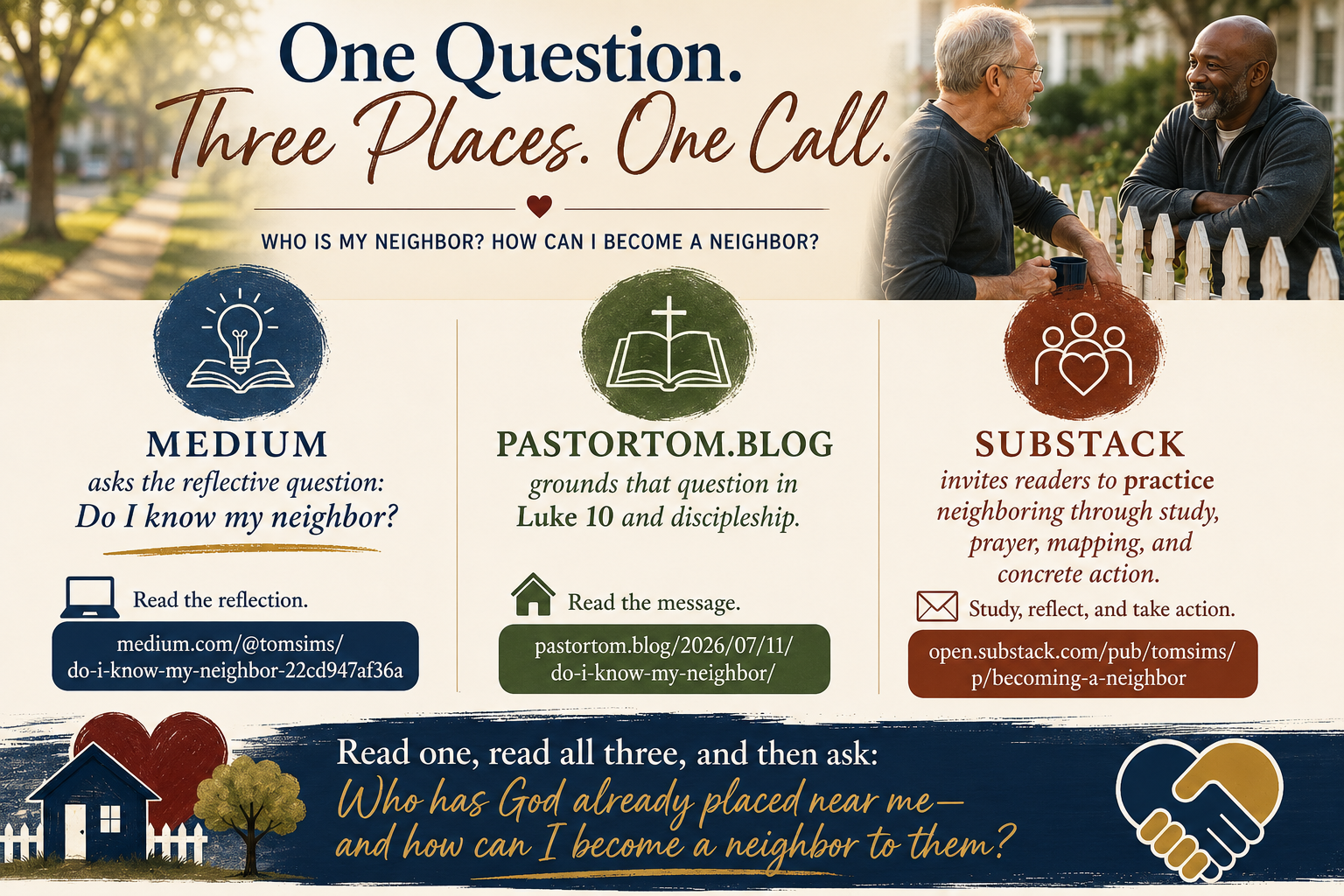
One question has now developed across three platforms:
Medium asks the reflective question: Do I know my neighbor?
https://medium.com/@tomsims/do-i-know-my-neighbor-22cd947af36a?sk=c090a737f65bf133a237ebd39100ff8f
PastorTom.blog grounds that question in Luke 10, the Good Samaritan, and the call to discipleship.
https://pastortom.blog/2026/07/11/do-i-know-my-neighbor/
Substack moves from reflection to practice through Bible study, prayer, neighborhood mapping, and concrete acts of love.
https://open.substack.com/pub/tomsims/p/becoming-a-neighbor?r=2m40s&utm_campaign=post&utm_medium=web&showWelcomeOnShare=true
Read one, read all three, and then ask:
Who has God already placed near me—and how can I become a neighbor to them?
The call to love our neighbor is not abstract. It becomes real through attention, interruption, conversation, prayer, compassion, and ordinary acts of kindness.
Subscribe for more Bible Chat reflections, practical discipleship resources, and conversations about faith, life, community, and the people God has placed around us.
https://tomsims.substack.com/
https://pastortom.blog/
https://linktr.ee/tomsims
#LoveYourNeighbor #GoodSamaritan #Luke10 #ChristianLiving #FaithInAction #BibleChat #Discipleship #Compassion #Community #PastorTom
 Pastor Tom's Community
Leave a comment