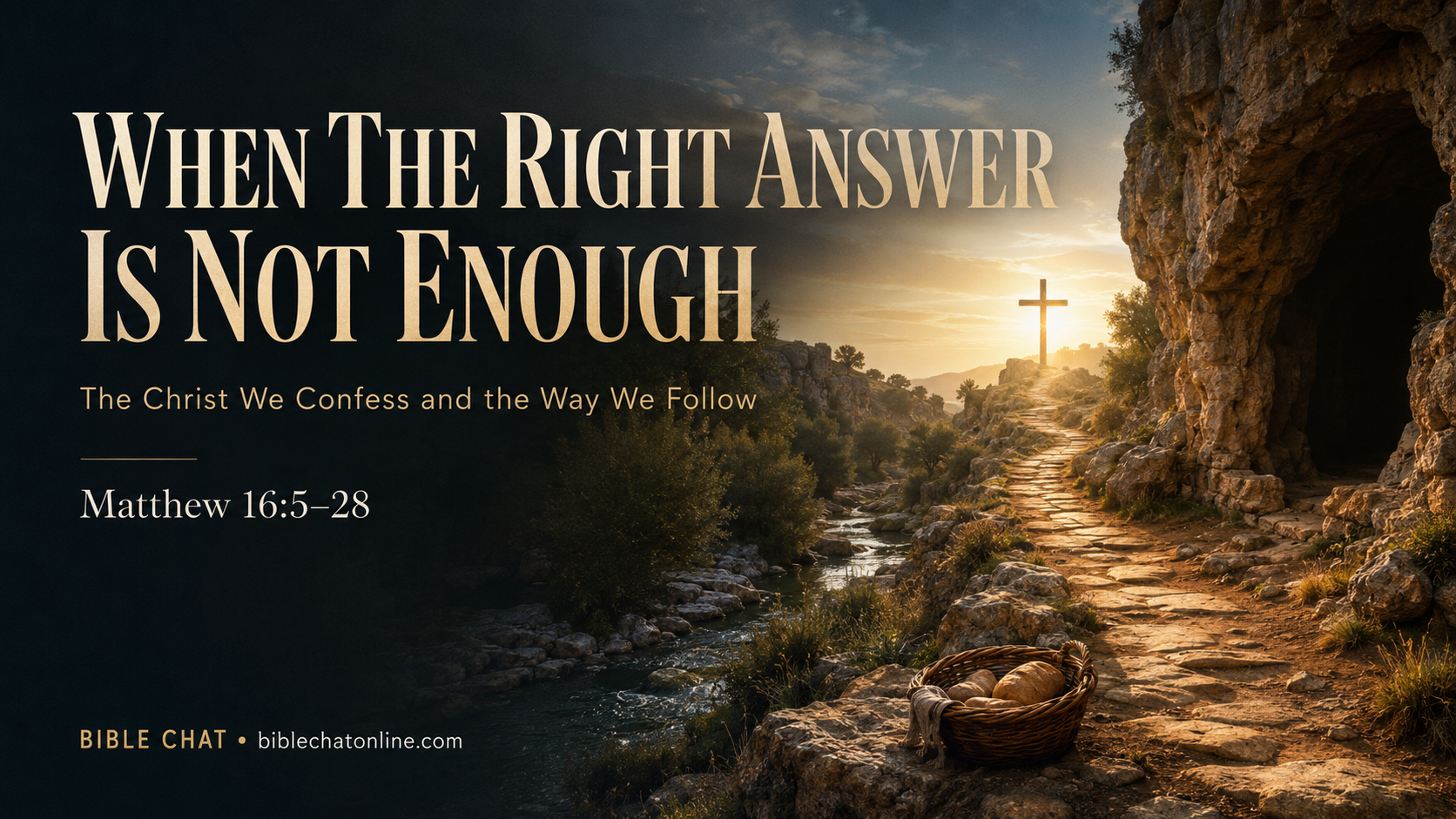
The Christ We Confess and the Way We Follow
Matthew 16:5–28
Peter gave the right answer about Jesus—and then immediately tried to tell Jesus how to be the Messiah.
That is one of the central tensions in Matthew 16. Christian faith requires a correct confession, but it does not end there.
It is not enough to confess Jesus as the Christ; we must allow the Christ we confess to reshape our minds and lead us in the way of the cross.
Last week, we considered the Pharisees and Sadducees demanding a sign from Jesus. They could interpret the appearance of the sky but could not discern what God was doing in front of them.
You can read that reflection here:
https://tomsims.substack.com/p/reading-the-red-sky
Now Jesus and his disciples cross to the other side—and the disciples forget to bring bread.
Remember the Bread
The disciples begin worrying that Jesus is criticizing them for forgetting lunch. Instead, Jesus directs their attention toward faith:
“Do you not remember?”
They had watched him feed five thousand people and collect twelve baskets of leftovers. They had watched him feed four thousand and collect seven baskets. Yet one forgotten loaf had them worried again.
Little faith forgets what grace has already placed in the baskets.
Faith does not deny the needs before us. Faith places those needs beside the evidence of God’s past faithfulness.
Beware the Yeast
Jesus warns the disciples about the yeast of the Pharisees and Sadducees.
Yeast is small and often hidden, but once it is worked into dough, its influence spreads. It affects how the dough rises, grows, and develops.
There is a lot of dough in the world. We must be careful about the yeast being worked into our hearts and minds.
What voices are shaping us?
What assumptions are influencing our understanding of God?
Are those influences making us more like Jesus, or are they quietly reshaping Jesus into our preferred image?
The Right Answer
At Caesarea Philippi, surrounded by competing claims about rulers, gods, identities, and power, Jesus asks:
“Who do people say that the Son of Man is?”
The disciples report what other people are saying. Then Jesus makes the question personal:
“But whom say ye that I am?”
Peter answers:
“You are the Christ, the Son of the living God.”
It is the right answer.
But the right answer is not enough.
When Jesus explains that he must go to Jerusalem, suffer, die, and rise again, Peter protests.
Peter wants the crown without the cross.
He wants resurrection without crucifixion.
He wants God’s outcome without God’s way.
He has the right title but the wrong script. He identifies Jesus as the Messiah and then tries to tell the Messiah how to be the Messiah.
Get Behind Me—and Follow
Jesus responds bluntly:
“Get behind me.”
Peter has stepped in front of Jesus and tried to redirect him. Jesus calls Peter back to the proper position of a disciple—behind him.
Then he says:
“If anyone wants to follow me, let them deny themselves, take up their cross, and follow me.”
The question is not only:
“Who do you say that I am?”
The question is also:
“Will you get behind me and follow?”
We can confess the correct creed and still resist the road on which Jesus leads us. We can sing that he is Lord and then spend the week trying to give him instructions.
The right answer is essential, but it is not the end of discipleship.
Remember the baskets.
Beware of the yeast.
Confess the Christ.
Take your place behind him.
Take up the cross.
Follow.
Continue the Study
The complete Bible Chat includes the full teaching, five practices for developing a cross-shaped faith, reflection questions, a weekly exercise, and prayer:
https://tomsims.substack.com/p/when-the-right-answer-is-not-enough
More writing, videos, Bible studies, and resources:
 Pastor Tom's Community
Leave a comment