Are You Optimistic?
The Online Etymology Dictionary is my friend. It often confirms my quasi-informed suspicions about words and their origins—including the word optimism.
When I say that I am optimistic, I want to know whether what I think I mean is what I am actually saying.
The word came into English through the French optimisme, derived from the Latin optimum and optimus, meaning “the best.” Gottfried Leibniz used optimum to describe “the greatest good.” Philosophically, optimism came to represent the belief that ours is the best of all possible worlds—a world in which the greatest good might be accomplished at the cost of the least evil. Online Etymology Dictionary
The greatest good. The least evil. The best of all possible worlds.
These are lenses through which I choose to view life. They are also goals I carry into every challenge, circumstance, and problem.
I am an optimist.
A pessimist—from the Latin pessimus, meaning “worst”—looks for the worst. But there is another outlook that can become an enemy of the optimum: settling for the minimum.
I am not making a value judgment about minimalism in art, design, or lifestyle. There can be great value in simplicity, especially when it frees us from excessive consumption and clutter. I am talking about something else: expecting the least from ourselves, from life, and from the possibilities hidden within our circumstances.
I am talking about our willingness to overcome obstacles and become all that we are capable of becoming.
Two people may live in similar circumstances, face comparable limitations, encounter the same kinds of challenges, and experience equal opposition—yet respond very differently.
Many factors influence the outcome. External circumstances matter. Opportunities are not distributed equally, and no two lives are identical. Nevertheless, each of us still makes choices within the circumstances we have been given.
One of the great deciding factors in life is whether we choose to believe the best, expect the worst, or settle for the least.
Our attitude does not magically erase obstacles or guarantee success, but it profoundly influences how we respond to what confronts us. It affects what we notice, what we attempt, how long we persist, and whether we rise after falling.
Scripture repeatedly calls us to pay attention to our inner lives:
“Keep thy heart with all diligence; for out of it are the issues of life.”
—Proverbs 4:23, KJV
Optimism is not fantasizing about a desired future. It is believing that a better future is possible and rallying our thoughts, prayers, choices, and actions toward its realization.
It is acting on what we believe and working for what we pray.
Proverbs 28:19 distinguishes between productive hope and empty fantasy:
“A hard worker has plenty of food, but a person who chases fantasies ends up in poverty.”
—Proverbs 28:19, NLT
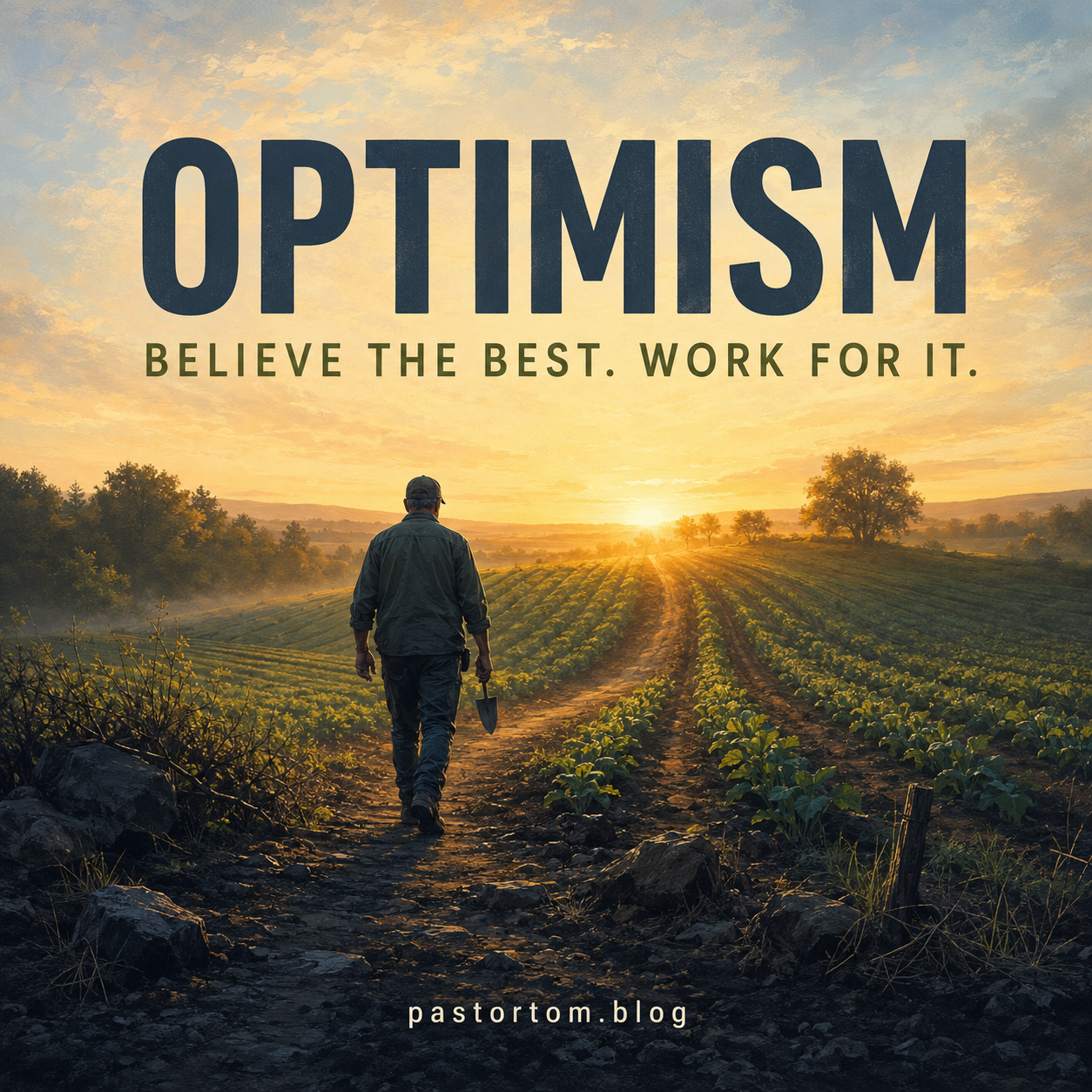
Before a farmer works the field, that farmer must believe that planting, tending, and waiting can produce a harvest. But for that belief to have practical validity, the farmer must do the work.
Belief and labor go hand in hand. Both exist within the realm of God’s sovereignty, grace, and love.
For those who enjoy acronyms upon which to hang their rhetorical hats, here is one for the optimist:
O — Over-the-obstacle thinking rather than under-the-circumstances living.
P — Positive about possibilities opened through proactive belief and action.
T — Truthful. The optimist does not bury his head in the sand. He stands firmly in the sand, sees it clearly, and looks beyond it.
I — Inspired and inspiring, drawing hope from life and offering hope to others.
M — Makes the best of things rather than surrendering to the worst or settling for the minimum.
I — Initiative-taking, choosing to act rather than merely waiting for things to work out.
S — Sacred values, providing the foundation upon which the optimist stakes everything.
T — Time and energy, willingly invested because meaningful possibilities require both.
Optimism is a choice.
I get a little shaky sometimes—I freely confess it. Yet, in the end, I choose optimism because surrendering to the worst or settling for the least is simply unacceptable.
 Pastor Tom's Community
Leave a comment